Cart Abandonment Rate Statistics (2026)

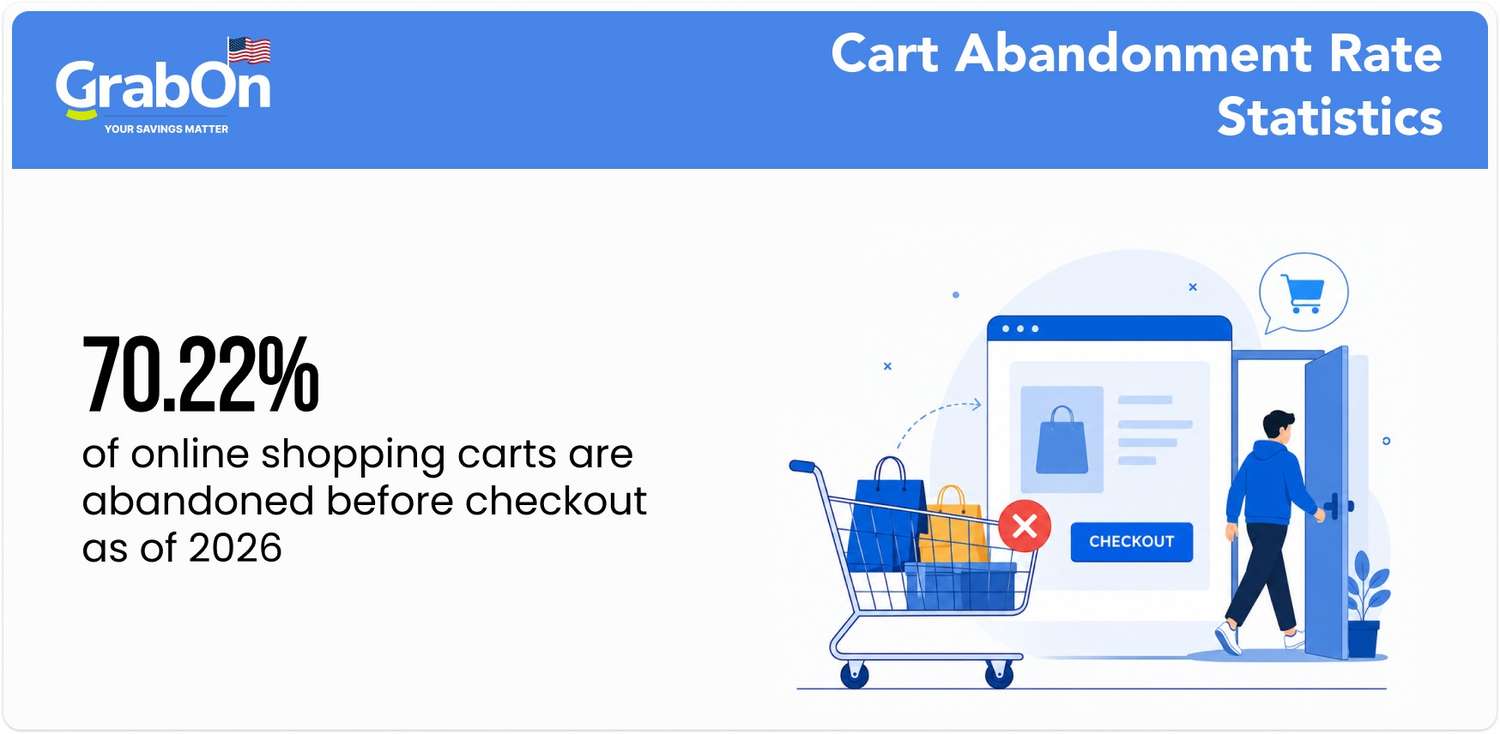
Cart abandonment is a common issue in eCommerce, with it averaging at 70.22% across all industries as of 2026.
Understanding the demographics and product categories most affected can help businesses refine their strategies to recover lost sales and improve conversions.
In this post, we uncover the key demographics and reasons behind cart abandonment while offering data-driven strategies to help businesses recover lost revenue.
Let’s get into it, shall we?
Top Picks
- 70.22% of online shopping carts are abandoned across all industries.
- Most shopping carts are abandoned due to the addition of shipping and tax fees during checkout.
- Shoppers aged 25-34 have the highest cart abandonment rate.
- Ecommerce brands lose an average of $18 billion in revenue every year due to shopping cart abandonment.
Average Cart Abandonment Rate in 2026
70.22% of online shopping carts are abandoned before checkout as of 2026. That is a 3.11% rise over the past decade. The top reason for cart abandonment is the extra cost of shipping and added taxes.
The highest recorded abandonment rate in e-commerce history was nearly 72% in 2012. It declined to 68.07% in 2014, but since then, shopping cart abandonment rates have steadily increased.
Source: Baymard cart abandonment report.
Top Reasons for Abandoning eCommerce Carts
48% of online shoppers abandon their carts after seeing the additional shipping and tax fees at the end of the checkout process. The mandatory account creation before checking out also triggers 26% of shoppers to abandon their carts.
Lack of trust with credit card data and slower delivery speed make 25% and 23% of shoppers abandon their carts, respectively.
| Reasons to Abandon eCommerce Shopping Carts | Share of people |
| Additional charges at checkout (shipping, tax) | 48% |
| Compulsory account creation before checkout | 26% |
| Lack of trust on the site with credit card data | 25% |
| Slow delivery speed | 23% |
| Long or complicated checkout process | 22% |
| I couldn’t see/calculate the total order cost up front | 21% |
| Unsatisfactory returns policy | 18% |
| The website crashed during checkout | 17% |
| Not enough payment methods | 13% |
| The credit card was declined | 9% |
Source: Statista.
Average Shopping Cart Abandonment Rate by Industry
The luxury and jewelry industry has the highest shopping cart abandonment rate at 81.68%. The Home and furniture industry follows on the second spot with a cart abandonment rate of 78.65%.
Here is a table showing the shopping cart abandonment rate across industries:
| Industry | Shopping Cart Abandonment Rate |
| Luxury and Jewelry | 81.68% |
| Home and Furniture | 78.65% |
| Fashion, accessories, and Apparel | 76.48% |
| beauty and Personal Care | 72.04% |
| Multi Brand Retail | 68.07% |
| Consumer Goods | 65.41% |
| Food and Beverage | 58.23% |
| Pet care and Veterinary services | 53.19% |
Source: Sellers Commerce.
Demographics of Shopping Cart Abandoners
Shoppers aged 25-34 have the highest cart abandonment rate, with 21% leaving items behind before completing a purchase. The 35-44 age group follows closely at 20%, while 45-54-year-olds abandon carts at a lower rate of 13%.
Among product categories, clothing sees the most abandoned items, accounting for 40% of unfinished purchases. Tech products come next at 18%, followed by homeware at 16%. These trends suggest that younger consumers may be more indecisive or price-conscious, while certain product types encourage more browsing before committing to a purchase.
Source: Sellers Commerce.
Lost Revenue To Abandoned Carts
Ecommerce brands lose an average of $18 billion in revenue every year due to shopping cart abandonment. $4 trillion worth of merchandise is expected to be abandoned in 2025 in digital carts.
That’s a huge chunk of money that can be recovered. Let’s look at some statistics about it below.
$260 billion worth of Merchandise Value Can Be Recovered
Optimizing checkout design presents a massive opportunity for ecommerce brands to recover lost revenue. Research shows that addressing usability issues in the checkout process alone can lead to a 35.26% increase in conversion rates for large ecommerce sites.
With $738 billion in combined ecommerce sales across the US and EU, this translates to a staggering $260 billion in potential recovered ordersall by improving checkout flow and design.
Source: Baymard Abandoned Cart Report.
5.08 steps is the average length of a checkout process across eCommerce sites
The average checkout process on eCommerce sites takes 5.08 steps. That’s longer than it should be, and it’s one of the reasons 22% of shoppers abandon their carts. To keep things smooth, aim for a 3-step checkout. Anything more feels like paperwork, not shopping.
Enabling guest checkout is a smart way to reduce drop-offs. If you need customer info, only ask for what’s truly necessary. And never make users enter the same details twice.
Source: Sellers Commerce.
Statistics on How To Recover Abandoned Carts
We at GrabOn believe in helping businesses from all aspects. we have talked about problems enough; now let’s talk about solutions.
We will have a look at different researches done on the recovery of abandoned carts and highlights the finding in this section.
- Improve The Average Checkout Flow
A complicated or time-consuming checkout process significantly reduces the chances of a completed purchase. As we saw earlier, 26% of shoppers abandon their carts due to a lengthy or overly complex checkout experience.
On average, ecommerce stores require 23.48 form elements and 14.88 form fields for new customers without an account, creating unnecessary friction that discourages conversions.
Try to reduce these steps as much as you can and improve the abandonment rate.
- Go About Free Shipping Without Taking a Hit on Finances
Shipping speed is a major factor in cart abandonment, with 24% of shoppers abandoning their carts because the retailer’s delivery options are too slow.
To reduce abandonment rates, consider offering free shipping and making it highly visible during checkout. You can offset costs by setting a minimum order value for free shipping or adjusting product prices to include shipping expenses.
We will cover a standalone blog on how to adjust shipping costs in your retail price.
- Shoppers Are More Likely to Abandon If Payment Options Are Limited
Payment flexibility plays a crucial role in online shopping decisions. Whether purchasing essentials or indulging in retail therapy, shoppers expect multiple payment optionsincluding Buy Now, Pay Later (BNPL).
According to Adobe, brands that offer BNPL see an 18% increase in average order size compared to other payment methods. More importantly, failing to provide diverse payment options could lead to lost sales, as 40% of shoppers may abandon their purchase if their preferred method isn’t available.
- Cart Abandonment Emails Are Your Best Friends
Cart recovery email campaigns are a powerful tool to win back lost revenue. Similar to retargeting ads, they use product data like items left in the cart, size, and color to remind shoppers to complete their purchase.
These emails perform exceptionally well, boasting an open rate of over 40%, nearly double the 21% benchmark for general retail emails. Plus, 50% of recipients click through, and half of those make a purchase.
For a successful cart recovery email, include a clear reminder of abandoned items and consider adding incentives like free shipping to encourage checkout completion.
Final Word
Cart abandonment is a challenge for online retailers. While not all abandoned carts can be recovered, optimizing the checkout process, offering multiple payment options, and using retargeting strategies can help regain lost sales.
A seamless shopping experience not only reduces abandonment but also strengthens customer relationships and boosts long-term loyalty.