Shein Statistics 2026: Net Worth, Revenue & SWOT Analysis

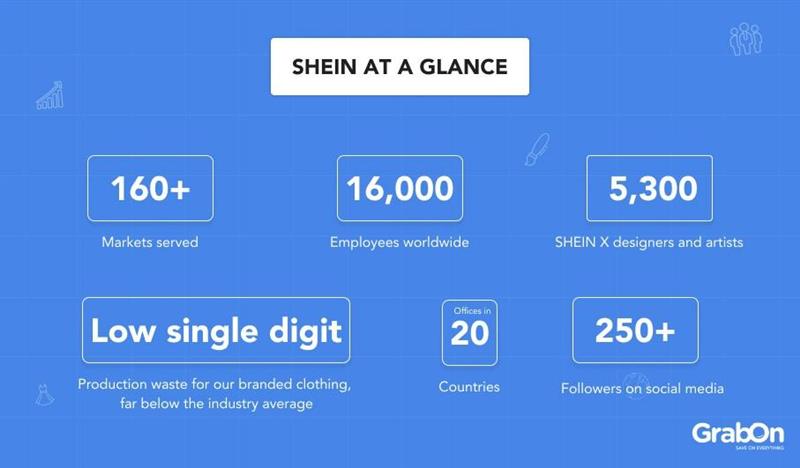
Originally known as Sheinside, Shein began as a wedding dress retailer in 2008 in Nanjing, China. Shein now serves a diverse customer base in over 160 countries, with more than 273 million active customers in 2026.
The pandemic years were a game-changer for Shein, with the user base increasing by 176.8% in 2020 and 181.9% in 2021.
Today, Shein is among the most in-demand fast fashion brands in the U.S., driven largely by its strong online presence. Although legacy brands like H&M and Forever 21 continue to dominate physical retail, Shein consistently leads in online engagement and popularity, especially with Gen Z consumers.
Let’s explore some impressive stats and trends behind Shein’s continued rise.
Shein’s Overview
| Category | Details |
| Company Name | SHEIN |
| Founded | 2008 |
| Founder | Chris Xu (also known as Xu Yangtian) |
| Headquarters | Singapore (relocated in 2022) |
| Originally Founded In | Nanjing, China |
| Industry | Fast Fashion / E-commerce |
| Products | Apparel, accessories, beauty, home decor, shoes, lifestyle goods |
| Business Model | On-demand manufacturing & direct-to-consumer online retail |
| Target customers | Primarily, Gen Z and younger Millennial consumers who want to buy trendy, low-priced fashion |
| Global Presence | Ships to 160+ countries |
| Offices | 40+ offices globally |
| Mobile App Downloads | 500M+ globally |
| Major Markets | US, UK, Europe, Middle East, Asia |
| Employees | 17,000+ employees globally |
| Key Strengths | Ultra-fast manufacturing, low prices, trend-driven designs, global logistics |
| Website | https://www.shein.com |
Shein Statistics 2026 (Editor’s Picks)
- Shein has more than 273 million active customers as of 2026.
- Shein reported $9.052 billion in revenue during Q1 of 2026.
- The Shein app has been downloaded over 1 billion times on Google Play.
- Shein adds 500 to 2,000 new pieces daily to its current collection of 600,000 styles.
- As of 2026, Shein reported having 17,751 employees globally.
- Shein generated $10.101 billion in U.S. net revenue in 2025.
Source: SheinGroup
What Is Shein Most Popular For?
Shein is popular due to its low prices, wide range of products, and quick production of trendy items. It gained even more popularity during the pandemic. The brand uses gamification and collaborates with social media influencers to boost its sales. The hashtag #sheinhaul has over 4.8 billion views on TikTok, becoming the fashion haul hashtag to receive the most views on TikTok.
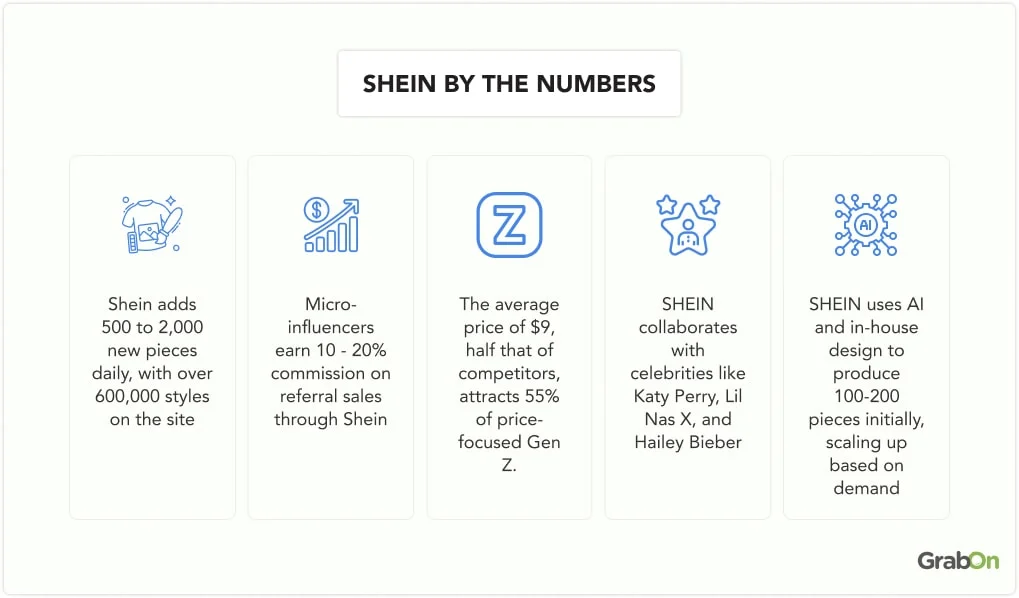
| Shein adds 500 to 2,000 new pieces daily, with over 600,000 styles on the site. |
| Micro-influencers earn 10 – 20% commission on referral sales through Shein. |
| The average price of $9, half that of competitors, attracts 55% of price-focused Gen Z. |
| SHEIN collaborates with celebrities like Katy Perry, Lil Nas X, and Hailey Bieber. |
| SHEIN uses AI and in-house design to produce 100-200 pieces initially, scaling up based on demand. |
 Source: Daxue Consulting, MobiLoud
How many people use Shein?
Shein has more than 273 million active customers globally. During the pandemic, Shein saw its most significant growth, with a 176.8% increase in users in 2020 and 181.9% in 2021, reaching 43.7 million users.
The app has attracted around 42.6 million downloads worldwide in the first 15 weeks of 2025.
Below is a table that shows the global user growth at Shein:
| Year | Number of Users |
| 2017 | 2.8 million |
| 2018 | 4.8 million |
| 2019 | 5.6 million |
| 2020 | 15.5 million |
| 2021 | 43.7 million |
| 2022 | 74.7 million |
| 2023 | 88.8 million |
| 2025* | 90 million* |
Source: BusinessofApps
Shein’s global user base reached more than 273 million active customers as of March 2026.
Shein’s global user base grew by 30X from 2017 to 2023.

Shein Users In The USA
Shein’s US user base is now estimated at around 25.7 million monthly active app users, up from earlier reports of 17.3 million.
The US is also Shein’s largest traffic market, accounting for about 31% of shein.com visits. In August 2026 alone, the site recorded roughly 88 million desktop visits from the US, with additional mobile traffic.
If you mix Shein hauls with Zara’s higher-end styles, you can benefit by using the latest Zara promo codes to balance fashion budgets.
The table below shows Shein’s rapid expansion in the US market over the years, reflecting significant annual growth rates:
| Year | Number of Users |
| 2017 | 0.49 million |
| 2018 | 0.67 million |
| 2019 | 1.12 million |
| 2020 | 2.8 million |
| 2021 | 7.5 million |
| 2022 | 13.7 million |
| 2023 | 17.3 million |
| 2026 | 25.7 million |
Source: BusinessofApps
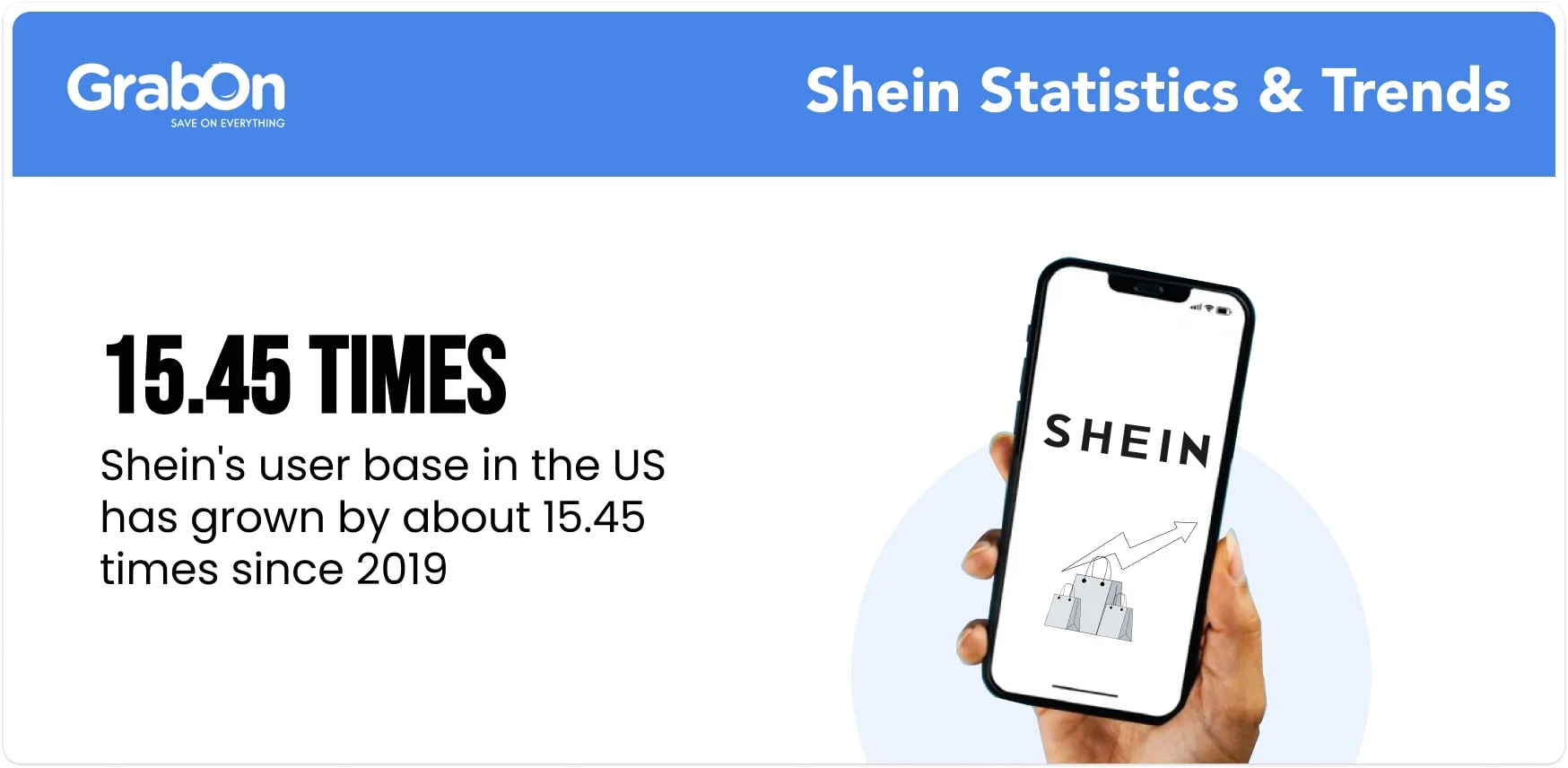
Shein’s user base in the US has grown by about 15.45 times since 2019.
Shein Demographics
Shein’s typical demographic is predominantly young women, with most of its user base being female. The average Shein shopper is a nearly 35-year-old woman who spends about $100 monthly on women’s clothing.
Shein’s appeal to younger generations is further highlighted by its strong presence on social media platforms like Instagram and TikTok, where the brand collaborates with influencers to connect with its target audience.
Shein Users By Gender
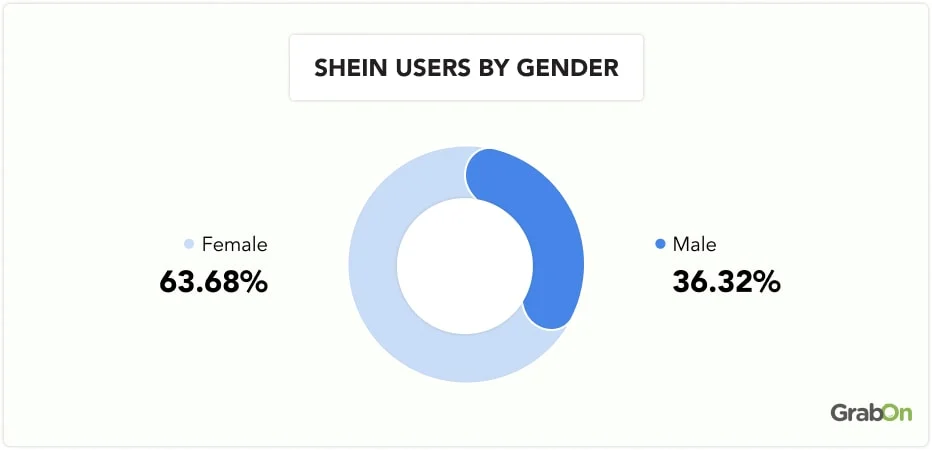
Roughly 2 in 3 Shein users are female, making up about 61.2% of its global visitors. This strong preference among female shoppers highlights Shein’s popularity in women’s fashion. In contrast, 38.8% of Shein’s users identify as male.
Source: SimilarWeb
Shein Users By Age
The majority of Shein users are aged between 25 and 34 years, making up about 26.12% of its total users. This shows that Shein is largely favored by millennials who enjoy shopping online. Following closely are users aged 35 to 44 years at 20.25% and those aged 18 to 24 years at 19.63%, showing Shein’s popularity among young adults and middle-aged consumers alike.
Refer to the table below to understand the distribution of Shein’s user base across different age groups.
| Age Group | Percentage |
| 18-24 years old | 19.63% |
| 25-34 years old | 26.12% |
| 35-44 years old | 20.25% |
| 45-54 years old | 15.05% |
| 55-64 years old | 11.59% |
| 65+ years old | 7.35% |
Source: SimilarWeb
What Is The Average Income Of A Shein Shopper?
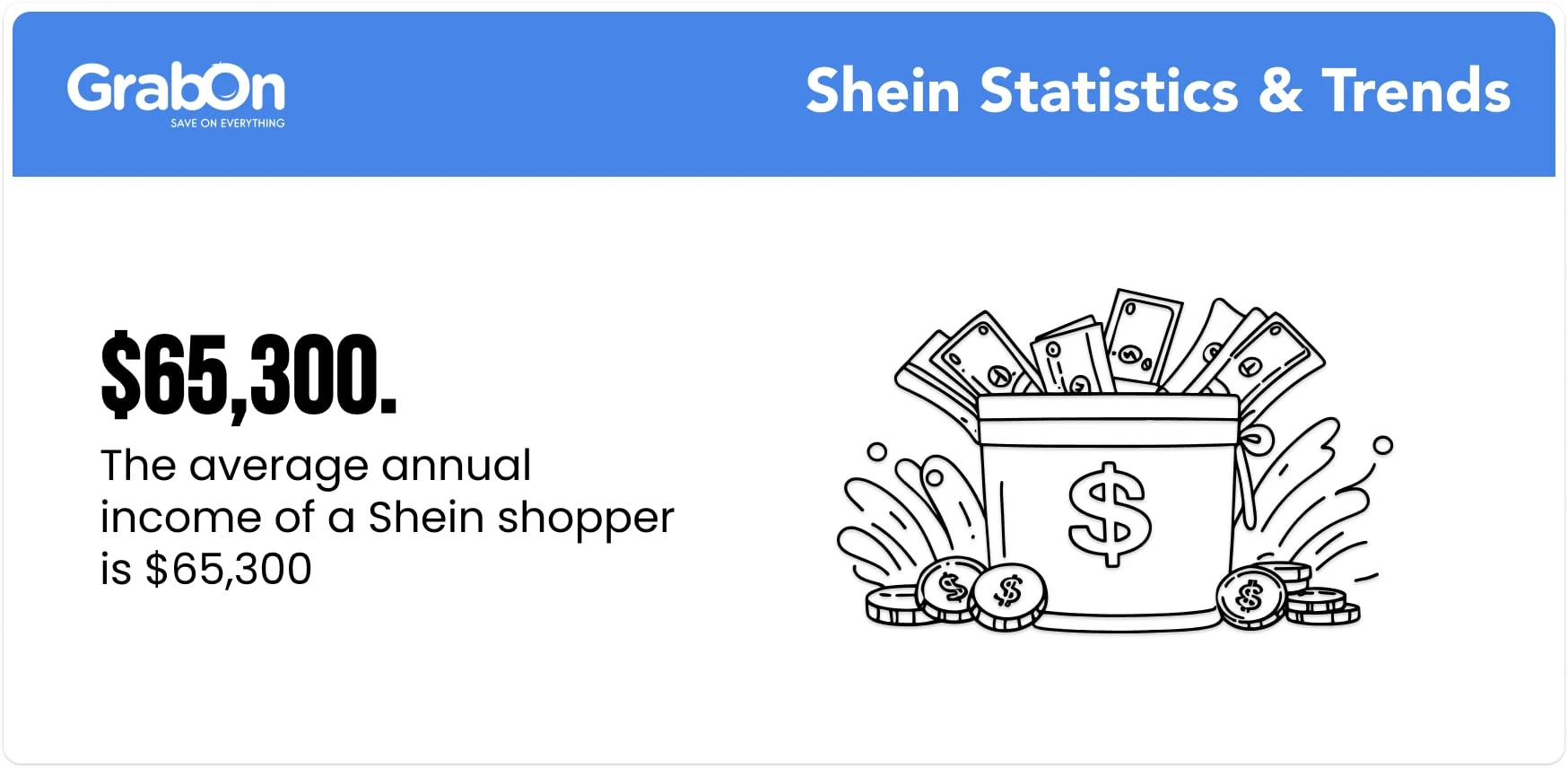
The average annual income of a Shein shopper is $65,300. Shein customers typically spend $100 per month on women’s clothing, which is 60% more than the average US woman.
These shoppers also make purchases more frequently, both online and in stores. In a survey that studied 684 regular Shein customers, it was found that 30% prioritize value and comfort over fashion, compared to 42% of average customers.
Shein shoppers also frequently shop at Amazon, Walmart, Target, and T.J. Maxx.
Shein’s Annual Revenue
As per the latest available data, Shein’s revenue stands at $41.847 billion. This means the fast fashion brand generates around $10.46 billion in revenue per quarter based on 2025 annual revenue.
Shein’s revenue grew by 8% in 2025.
Shein’s fast-fashion dominance is often compared with other large online retailers like Amazon, which also offers extensive fashion collections through multiple sellers and brand stores. Shoppers frequently cross-check Shein discount offers with Amazon to find the best combination of price, variety, and delivery options.
Compared to similar fashion retailers like Macy’s, Shein focuses more on fast-changing styles and low-cost production, while Macy’s emphasizes branded apparel and seasonal department store promotions.
In the broader online retail space, platforms such as AliExpress also compete in the value-driven segment by offering a wide range of budget-friendly products across fashion, accessories, and lifestyle categories through global sellers.
Meanwhile, eBay offers continues to serve as a flexible marketplace where shoppers can find both new and second-hand fashion items at competitive prices through seller-based listings.
Explore Shein’s annual revenue growth from 2019 to 2025:
| Year | Shein’s Revenue (in USD) |
| 2019 | 4 billion |
| 2020 | 10 billion |
| 2021 | 15.7 billion |
| 2022 | 23 billion |
| 2023 | 32.2 billion |
| 2024 | 50 billion |
| 2025* | 41.8 billion |
Shein’s Net Profit
Shein is targeting $2 billion in profits in 2025, compared to the $1.1 billion in 2024. The company says this expected jump is due to a combination of price increases, cost-cutting measures (including reduced marketing spending), and improved margins, which offset a decline in traffic caused by new U.S. tariffs.
Their first-quarter 2026 performance recorded a net loss of US$99 million, with revenue of $9.052 billion.
In 2023, Shein achieved a record profit of over $2 billion, a 185% increase from the previous year. The platform also recorded around $45 billion in gross merchandise value.
Shein’s 2023 profits not only surpassed the $700 million net income from 2022 but also exceeded the $1.1 billion net income from 2021 by 81.8%.
What Is Shein’s Net Worth?
Shein’s net worth, or company valuation, in 2025 was widely reported to be around $30 billion, a significant drop from its $66 billion valuation in 2023 and its $100 billion peak in 2022. Shein completed its Hong Kong stock market debut in September 2026 at a valuation of about $26.3 billion. This decline is attributed to slowing revenue growth, increased competition (notably from Temu), and regulatory risks, especially in the U.S. market.
Ahead of its Hong Kong IPO, Shein faced further pressure from investors to potentially cut its valuation even lower.
Despite a 19% increase in sales to $38 billion, Shein’s net profit fell by nearly 40% to $1 billion in 2024, missing its internal projections and further impacting its valuation.
The table below lists Shein’s valuation over the years:
| Year | Valuation (USD) |
| 2019 | 5 billion |
| 2020 | 15 billion |
| 2021 | 47 billion |
| 2022 | 100 billion |
| 2023 | 66 billion |
| 2024 | 45 billion |
| 2025 | 30 billion |
| 2026 IPO | 26.3 billion |
Source: BusinessofApps, Reuters, Forbes
Shein’s Market Share
Shein is one of the largest players in the fast fashion industry and has overtaken competitors like H&M and Zara in the U.S. market over recent years. According to market reports, Shein’s share of the U.S. fast fashion market grew significantly from around 18% in 2020 to roughly 40-50% by 2022, surpassing rivals such as H&M and Zara. Its strong online presence and highly targeted social media strategies have helped it build a leading position in a competitive industry.
Number Of Shein Employees
Shein has more than 17,000 employees globally as of 2026. The company expanded its team by hiring individuals from 27 different nationalities in 2022 alone. From its inception, Shein has supported female leadership, with 2 of its 4 founders being women. This commitment is noticeable in the workforce, where 5% of Shein’s employees are women, and 40% of senior management positions are held by women worldwide.

How Much Do Shein Workers Get Paid?
Shein factory workers earn between 6,000 yuan and 10,000 yuan monthly, which roughly translates to $831 to USD 1,385. Despite these wages, they work extensive 75-hour weeks.
After deducting overtime pay, the average monthly salary drops to about 2,400 yuan or $332 – well below China’s estimated living wage of 6,512 yuan ($900). Other provinces like Hubei, Hunan, and Jiangxi, where some production steps are outsourced, have even lower minimum wages.
Shein App Downloads
SHEIN’s app downloads have grown impressively over the years. From 2017 to 2023, downloads increased by around 1,302%, showing its rising global popularity. In 2023, the app was downloaded around 262 million times, making it the most downloaded fashion app of the year.
Number of Shein App Downloads Globally
The SHEIN app has over 500 million downloads on the Google Play Store, ranking 7th in the USA under the category of Free Shopping apps. On the iOS App Store, SHEIN has over 1.1 million ratings and usually ranks among the top 10 in the Shopping category.
In 2024, Shein’s app had 136.98 million downloads recorded year-to-date by July. Based on this pace, Shein could potentially reach between 275 million to 300 million app downloads by the end of the year.
Shein had risen to become the world’s leading fashion retailer by 2022. There were around 262 million app downloads worldwide by 2023, highlighting its widespread appeal.
Estimated Shein App Downloads for 2024:
| Year | App Downloads |
| 2015 | 2.71 million |
| 2016 | 10.23 million |
| 2017 | 18.66 million |
| 2018 | 59.06 million |
| 2019 | 68.26 million |
| 2020 | 123.43 million |
| 2021 | 177.49 million |
| 2022 | 195.84 million |
| 2023 | 261.94 million |
| 2024 | 235 million |
Source: Statista
Shein App Downloads In The US
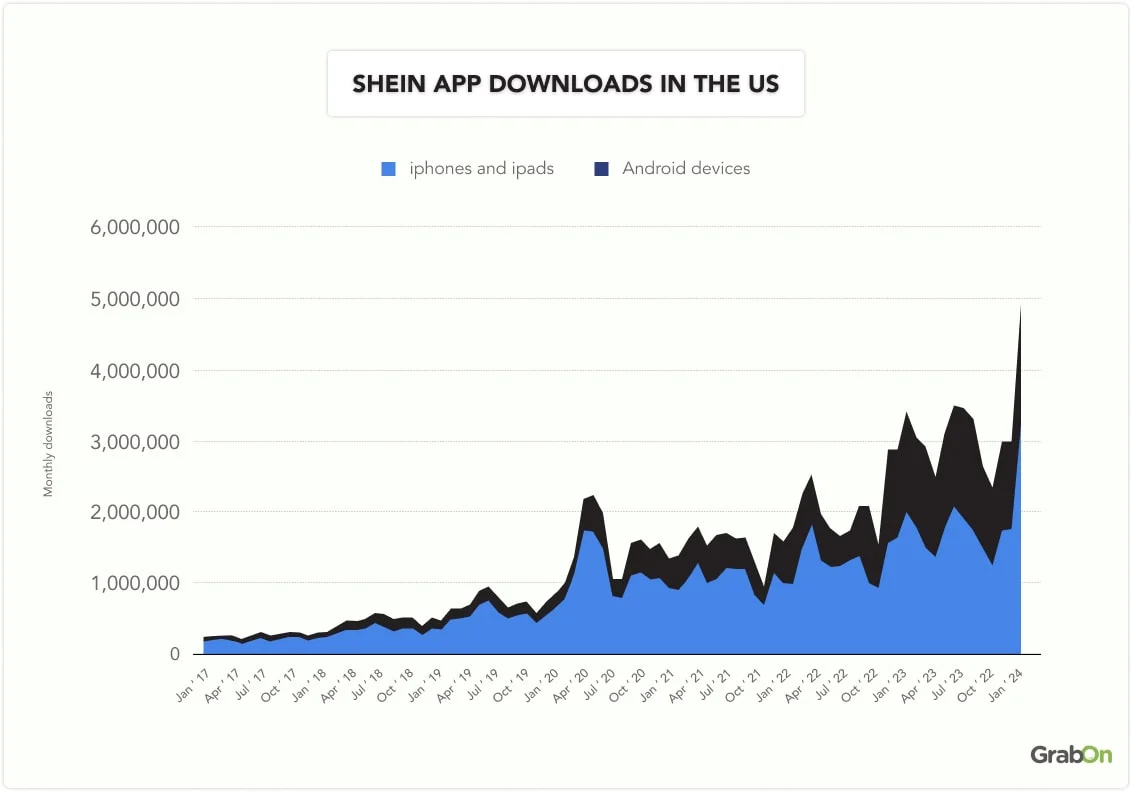
In February 2025, the Shein app registered about 1.2 million downloads in the US from iPhones and iPads, compared to around half a million downloads from Android devices. Shein’s mobile store is, in fact, one of the most downloaded shopping apps in the U.S.
Most Shein mobile app downloads occur on iOS devices in the US as shown in the chart below:
Source: Statista
Shein’s Most Active Markets
In 2023, Shein had 53.27 million app downloads in Brazil, the highest worldwide. The United States followed with 36.51 million downloads, and Mexico had 27.35 million downloads. The combined downloads from the Philippines, Saudi Arabia, Spain, France, Japan, the United Kingdom, and Italy accounted for roughly 25% of Shein’s global app downloads.
Explore Shein’s global app downloads across key markets:
| Country | Downloads |
| Mexico | 37.18 million |
| United States | 36.36 million |
| Brazil | 28.6 million |
| Philippines | 11.04 million |
| Saudi Arabia | 10.18 million |
| Spain | 7.98 million |
| France | 7.67 million |
| Japan | 7.47 million |
| United Kingdom | 7.36 million |
| Italy | 6.31 million |
Source: Statista
Shein’s User Engagement Statistics
The majority of Shein’s visitors access the site via mobile devices, which account for 76.65% of total traffic. Desktop users make up the remaining 23.35%.
In August 2026, Shein recorded about 282.6 million total visits.
Users spend an average of nearly 9 minutes (9 minutes and 2 seconds) per session on Shein’s website. Shein maintains a bounce rate of around 57.85%, indicating that roughly 6 in 10 visitors leave the site after viewing just one page.
Most of Shein’s web traffic comes directly (59.94%), followed by Google (13.93%). Paid search and social media also contribute a notable share to overall visits.
- Website traffic stats:
- Total visits: 282.6M
- Organic traffic: 41.68M
- Paid traffic: 4.43M
Source: similarweb
Shein Customer Experience
Shein, the global fast-fashion powerhouse, boasts over 1.1 million ratings on the Apple App Store with an impressive average of 4.6 out of 5 stars, reflecting strong user engagement and widespread satisfaction with its app experience. Customer satisfaction (CSAT) scores for Shein hover between 63% and 67%, with the highest satisfaction reported among female shoppers and those aged 18-25.
Despite its popularity and high engagement, especially among Gen Z, Shein’s Net Promoter Score (NPS) is notably negative at -30, indicating that while many users enjoy shopping on the platform, they are less likely to recommend it to others. Product quality remains a key concern, with ratings averaging just 2.1 out of 5 stars among younger female customers, suggesting persistent issues with garment durability and material feel.
SHEIN’s SWOT Analysis
SHEIN’s rapid rise in the global fast-fashion market makes it important to understand the strengths and challenges shaping its growth in 2025. A clear SWOT analysis helps break down where SHEIN stands today, and what could influence its next phase of expansion.
| Category | Key Points |
| Strengths | • Strong online presence & global reach: SHEIN operates exclusively online, ships to 160+ countries, and reaches a global customer base.
• Fast-fashion business model & speed: The company’s ability to rapidly design, produce, and launch new styles lets it stay on top of trends and push frequent product drops. • Competitive pricing and value proposition: Low prices and frequent promotions make SHEIN attractive to price-conscious consumers. • Wide product range and diversity: Offering clothes, accessories, home goods, and more, appealing to a broad demographic (women, men, kids, home shoppers). • Data-driven marketing & personalization: Use of data analytics to tailor product recommendations and marketing, optimizing customer experience and conversion. |
| Weaknesses | • Quality and product-consistency concerns: Because of fast production and low cost, some items may exhibit inconsistent quality, which can hurt customer trust and brand reputation.
• Supply-chain transparency & ethical concerns: Allegations around labor conditions, lack of transparency in sourcing, and environmental impact pose reputational risks. • Dependence on online-only model and third-party platforms: Without physical retail footprint, SHEIN’s sales are vulnerable to digital-platform disruptions or regulatory changes. • Reputation risks regarding “fast-fashion” image: Growing criticism of fast fashion (environmental, ethical) may limit appeal to conscious consumers. |
| Opportunities | • Expansion into new markets / demographics:The global online model allows SHEIN to target emerging markets and broaden demographic reach (age groups, income tiers, regions).
• Diversification of product lines & brand extensions: Potential to add premium lines, sustainability-oriented collections, home goods, accessories, or even offline/pop-up stores. • Leverage technology & personalization: Further investing in AI, data analytics, AR/VR (virtual try-on), and personalized shopping to improve user experience and retention. Shifting consumer behavior: As online shopping continues to grow globally, SHEIN can benefit from rising e-commerce adoption, especially in younger, trend-driven demographics. |
| Threats | • Intense competition: Numerous global and local fashion retailers (online & offline) compete for similar customer segments, which can erode market share or force price wars.
• Regulatory, ethical, and reputational pressures: Rising scrutiny over labor practices, environmental impact, and “fast-fashion” ethics can lead to negative public perception or compliance costs. • Supply-chain risks & global disruptions: Dependence on international manufacturing, global logistics, and third-party suppliers makes SHEIN vulnerable to supply-chain disruptions, geopolitical tensions, tariffs, or trade restrictions. • Changing consumer preferences: As more consumers demand sustainable, ethical, or higher-quality fashion, SHEIN’s fast-fashion, low-cost model may become less attractive to certain segments. |
The Future Of Shein’s Expansion
In the coming future, Shein aims to diversify beyond clothing into home, beauty, and toy markets. By participating in panels with major brands like Colgate-Palmolive and Hasbro, Shein will establish itself in new sectors. The company plans to operate as a marketplace, allowing third-party sellers to list their products, similar to Amazon and AliExpress, with services already available in the US and UK, and plans to expand into Europe.
Despite facing scrutiny over labor practices, Shein’s strong financial backing (as seen above) provides the resources to address these issues. By opening its platform to third-party sellers, Shein aims to replicate Amazon’s success, particularly in the beauty sector, where it has already seen positive results with its Sheglam brand.