Converse Statistics: Market Share, Demographics, Revenue (2026)

Converse is one of the biggest lifestyle brands, with a global presence in over 160 countries in 2026. It operates more than 136 physical stores worldwide and has a strong e-commerce presence. As of now, the Converse employee count is over 4,407 in the US, and the company plans to expand this number in the future.
Currently, Converse holds around 5% of the global sneaker market share and generated revenue of around $264 million as of the third quarter of fiscal year 2026.
In this blog, we will explore some of the latest statistics of Converse, which will help you get detailed insights on the brand’s user demographics, employee and store count, and total annual and quarterly revenue.
Converse Company Brief
| Company Name | Converse Inc. |
| Founded | 1908 |
| Founder | Marquis Mills Converse |
| Headquarters | Boston, Massachusetts, USA |
| Parent Company | Nike, Inc. (acquired in 2003) |
| Industry | Footwear, Apparel, and Accessories |
| Best-Known Products | Chuck Taylor All Star, Chuck 70, One Star, Run Star Hike |
| Core Identity | Heritage sneaker brand known for timeless, minimal, and customizable designs |
| Global Presence | Sold in 160+ countries worldwide |
| Target Audience | Youth, creatives, streetwear enthusiasts, and everyday casual wear consumers |
Converse Statistics At a Glance
- Converse currently operates around 136 offline stores globally.
- Converse generated $264 million in revenue in the third quarter of fiscal 2026, a 35% decline year-over-year.
- Converse generated $264 million in revenue in the third quarter of fiscal 2026, a 35% decline year-over-year.
- California has around 17 Converse stores, the most of any state in the United States.
- 6 out of 10 Converse consumers are females in the United States compared to 42% of males.
- About 18.73% of the brand’s customers are Gen Z, and 29.27% are millennials.
Converse User Demographics
Converse is highly popular among sneaker owners in the US. Their products have a high retention percentage among their customers. According to various reports, most of Converse’s customers are female, and they are aged between 18 and 34 years. Let’s check some of the key statistics related to Converse user demographics:
- Around 9 out of 10 sneaker owners in the United States know about Converse and its products, like shoes, clothing, and accessories. Out of them, about 26% own a pair of Converse sneakers.
- 19% of Converse sneaker owners, who make up 26% of the total, are most likely to repurchase from the brand. Upon calculation, we can conclude that the retention rate of Converse products is around 73%. This strong loyalty is also why many repeat buyers actively look for Converse coupon codes before making their next purchase, helping them save while sticking with a brand they trust.
- About 57% of Converse customers in the US are female, whereas the remaining 43% are male.
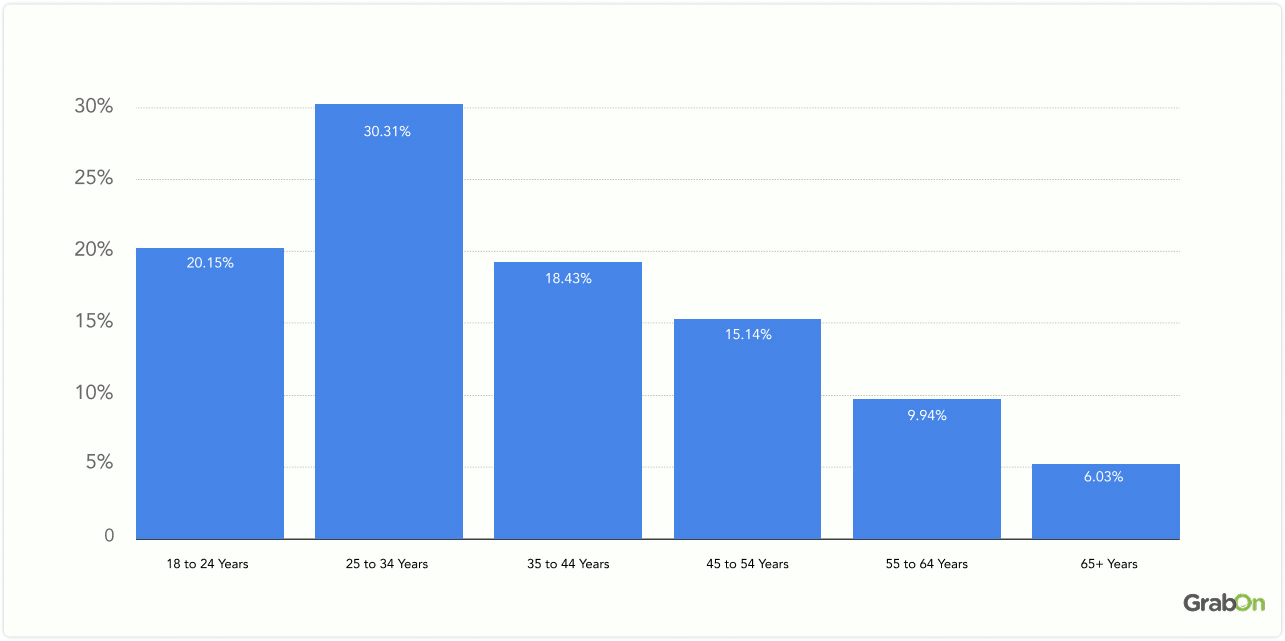
Over half of Converse’s customers in the United States are aged 18 to 34 years. While around 18.43% of their customers are between 35 and 44 years old.
Here is the table to showcase the distribution of Converse customers by age group:
| Age Group | Share of Converse customers |
| 18 to 24 years | 20.15% |
| 25 to 34 years | 30.31% |
| 35 to 44 years | 18.43% |
| 45 to 54 years | 15.14% |
| 55 to 64 years | 9.94% |
| 65+ years | 6.03% |
Source: Statista 1, SimilarWeb
Converse Company Statistics
Converse has a presence in more than 160 countries, and it plans to add more in the future. The brand also employs thousands of employees of different ethnicities. More than half of their employees are female compared to male and are aged below 30 years. Here are key Converse company statistics you should check:
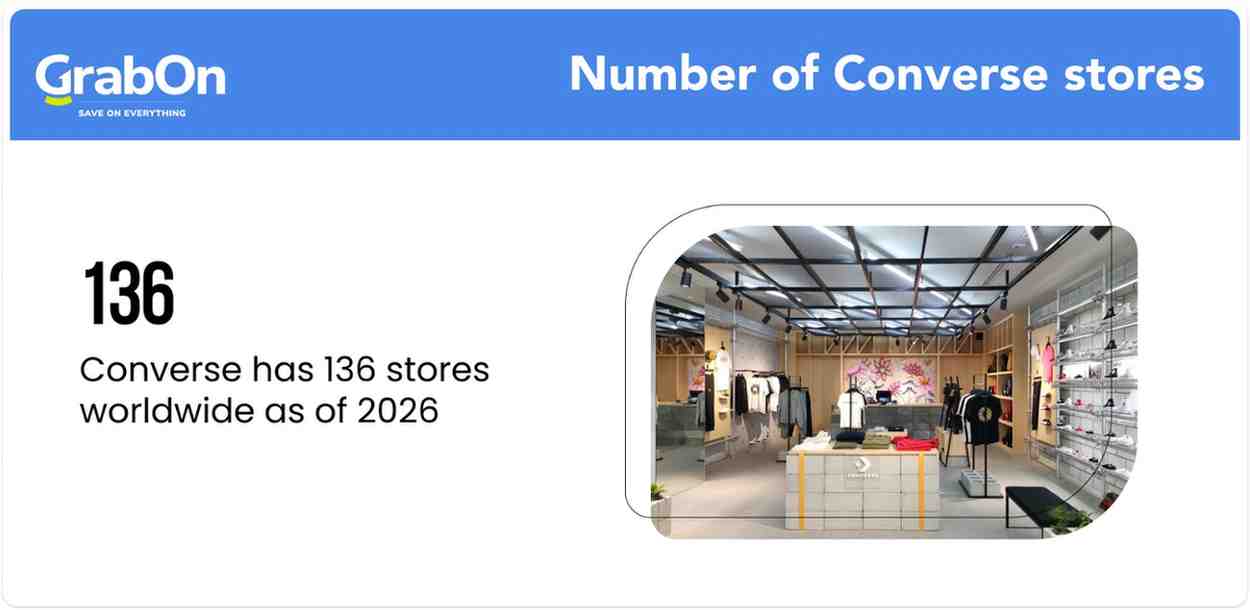
As of 2026, Converse has 80 stores in the United States and 56 stores in other international locations. Combinedly, it has around 136 stores worldwide.
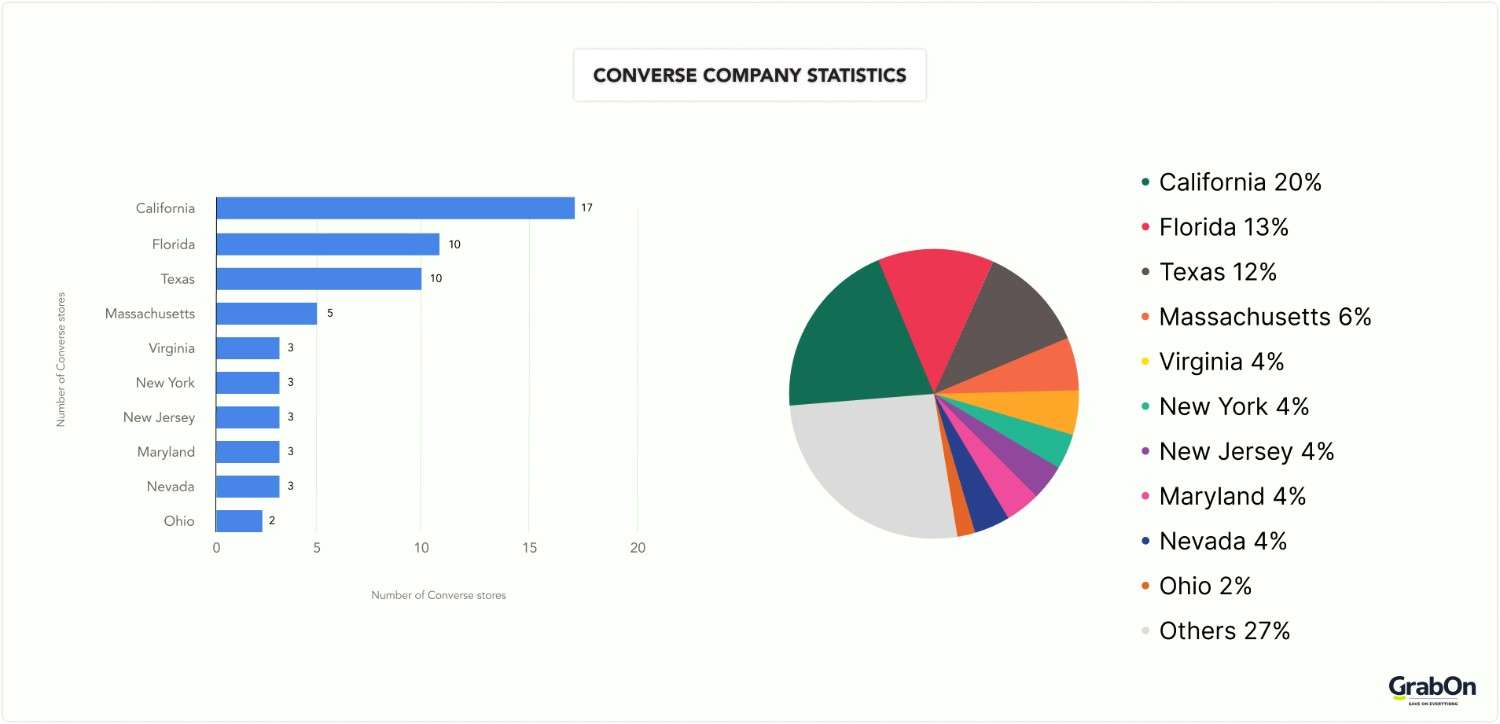
- California has the highest number of Converse stores in the United States. There are around 17 offline stores in the state, which is around 21% of the total stores of the brand. Florida and Texas are in the second and third spots on the list with 10 Converse stores each.
- All the Converse stores in the country are concentrated in 27 states and territories. There are also 29 states and territories where no stores are located.
The table below shows the number of Converse stores by US state:
| US States | Number of Converse stores | Share of Converse stores |
| California | 17 | 21% |
| Florida | 10 | 12% |
| Texas | 10 | 12% |
| Massachusetts | 3 | 4% |
| Virginia | 3 | 4% |
| New York | 3 | 4% |
| New Jersey | 3 | 4% |
| Maryland | 3 | 4% |
| Nevada | 3 | 4% |
| Ohio | 2 | 2% |
- Orlando and Las Vegas combinedly have the most Converse stores of any city in the U.S., with 2 offline locations.
- Converse has over 4,407 part-time and full-time employees in the United States. As the brand is opening new stores every year, its employee count is also increasing.
- Almost 51% of Converse employees in the United States are female, totaling about 2,248, while 49% are male, making up 2,159 employees.
- 6 out of 10 Converse employees in the US are White, whereas 25.2% identify themselves as Hispanic/Latino. Another 10% of employees are African Americans, and Asian Americans account for around 6.3% of the total employee count.
Here is the table that shows the distribution of Converse employee by their racial background:
| Race/Ethnicity | Share of Converse Employees |
| White | 55.2% |
| Hispanic or Latino | 25.2% |
| African American | 10% |
| Asian | 6.3% |
| Unknown | 3.3% |
- 6 out of 10 Converse employees are aged between 20 and 30 years, while 23% are between 18 and 20 years old. Only 2% of their employees are aged above 40 years.
The table below shows the distribution of Converse employees by age:
| Age Group | Share of Converse Employees |
| Less than 18 years | 4% |
| 18 to 20 years | 23% |
| 20 to 30 years | 57% |
| 30 to 40 years | 12% |
| Above 40 years | 2% |
- 4 out of 10 Converse employees earn between $40k and $60k annually, while 29.8% make around $60k to $100k per year. Only 4.9% of their employees are on the higher payroll of over $200k per year.
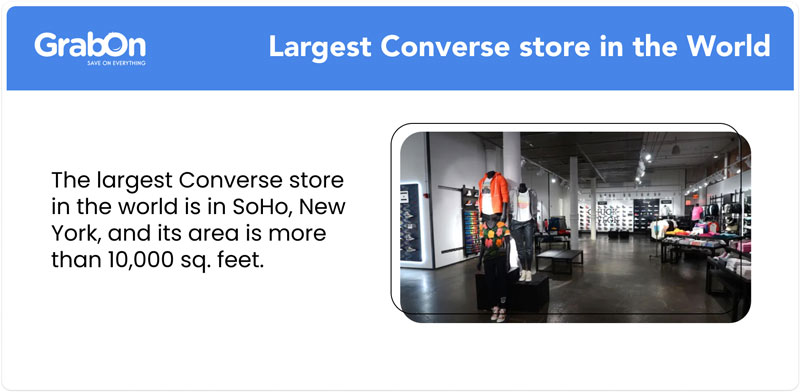
- The world’s largest Converse store is situated in SoHo, New York, United States. This two-story flagship store is spread over 10,000 square feet and houses some of the exclusive limited-edition products from the brand.
- Compared to other sneaker brands, Converse stands in the 7th position with 5% of the total market share worldwide. Nike tops the list with an 18% market share, followed by Air Jordan with an 11% share. In the top 10 list, Nike and its subsidiaries – Air Jordan and Converse combinedly have 34% of the market share.
Source: Nike Investor Relations, ScrapeHero, Zippia, Converse, Statista
Converse Revenue 2025 – 2026
Converse is owned by Nike, and its revenue is reported as part of Nike’s overall earnings. The combined revenue of Nike and Converse makes up a significant portion of Nike’s annual income. Below, you can check some of the important Converse revenue statistics:
- Converse’s fiscal year 2026 is underway, and it has released revenue data through the 3rd quarter. According to their report, Converse generated a revenue of $264 million worldwide in the third quarter of 2026 (ended February 28, 2026), which is a 35% decline compared to $405 million in the same quarter of the previous year and 12% less than $300 million in Q2 of fiscal 2026.
This marks the fifth consecutive quarter of double-digit revenue declines for Converse. The brand also swung to an EBIT loss of $40 million in Q3, compared to a $39 million profit in the same period last year, an $80 million swing in operating results. Nike expects Converse to face continued headwinds through the remainder of fiscal 2026.
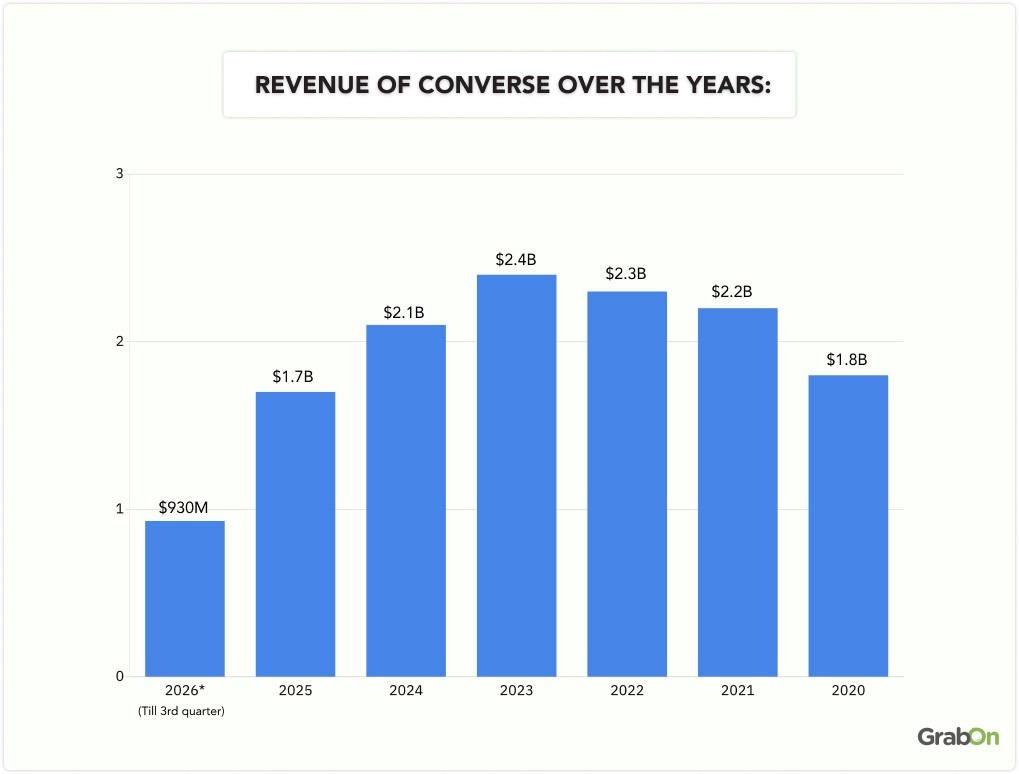
The table below shows the revenue of Converse over the years:
| Fiscal Year | Converse Worldwide Revenue | Year-on-Year Change |
| 2026* | $930 million* (Till 3rd quarter) | 30.3% less than (Q1, Q2, and Q3 of 2025) |
| 2025 | $1.7 billion | -19% |
| 2024 | $2.1 billion | 12.5% |
| 2023 | $2.4 billion | + 4.35% |
| 2022 | $2.3 billion | + 4.55% |
| 2021 | $2.2 billion | + 22.22% |
| 2020 | $1.8 billion | 5.26% |
- Upon calculating the average daily revenue of Converse in the third quarter of fiscal year 2026 is around $2.93 million. This is 12.3% less than Q2’s average of $3.30 million per day and 27.8% less than Q1’s $4.06 million per day, showing an accelerating decline through the year.

- Each store of Converse worldwide generated an average revenue of $1.94 million for the third quarter of fiscal year 2026, down from $2.21 million per store in Q2.
- As Nike owns Converse, their annual report includes Converse’s performance. Their annual report revealed that combined sales from Converse and Nike made up about 43% of total revenue in the U.S. and around 57% of international revenue.
Source: Nike 1, Nike 2, Statista
Case Study of Converse’s Comeback from Bankruptcy
Converse was established as a rubber company in 1908 and became highly popular with its tennis shoes. Later in 1917, they started getting globally recognized for their Chuck Taylor All-Stars basketball shoes. However, the brand faced multiple financial challenges in the late 1990s due to intense competition. This resulted in a decrease in their sales, and eventually, Converse declared bankruptcy in 2001.
Reasons behind the failure of Converse
Here are some of the key reasons that resulted in Converse’s failure:
- Market Saturation and Competition: The products offered by Converse in the 1990s were outdated compared to those of established players, such as Nike, Adidas, Reebok, and others. Their innovative designs left no room for Converse to rise and eventually lose market share to them.
- Brand Stagnation: Converse failed to innovate or update its product lineup and relied solely on its classic designs. It also failed to adapt to the latest tastes of its customers.
- Financial Mismanagement: The brand made several poor financial decisions, including an over-reliance on high-interest debt. This further weakened its financial position.
The Comeback and Current Success
After filing for bankruptcy, Converse made some bold and serious decisions that helped it bounce back from its failures. Here are some of these strategies:
- Acquisition and Turnaround: Just after 2 years of its bankruptcy, in 2003, Nike acquired Converse for $305 million, marking the beginning of a major turnaround.
- Rebranding and Marketing: Nike made some strategic moves, like repositioning Converse as a lifestyle brand and focusing on its vintage appeal. This time, the brand targeted younger and fashion-conscious consumers, which improved its market presence.
- Product Innovation: Nike also introduced new product lines under Converse and made some high-profile collaborations with designers and celebrities. These limited-edition releases generated significant buzz and renewed interest in Converse.
- Global Expansion: Converse used Nike’s extensive distribution network and expanded into new markets in Europe and Asia, like India, China, Japan, and Germany.
- Digital Transformation: Nike made significant investments in Converse’s e-commerce capabilities to improve the online shopping experience. It also used its data-driven marketing strategies to connect with consumers.
- Results and Impact: All the above strategies helped Converse positively. By 2014, it had transformed into a cultural icon, generating over $2 billion in annual sales. The brand’s successful repositioning and strategic initiatives revitalized its image and financial performance.
Final Word
Despite filing for bankruptcy in 2001, Converse has emerged as one of the major lifestyle brands in the United States. It grew at an average growth rate of 4.65% from fiscal years 2021 to 2024 but has since entered a sharp decline, with FY2025 revenue falling 19% to $1.7 billion and FY2026 revenue through three quarters totaling just $930 million — a 30% decline year-over-year. The brand is now operating at EBIT losses and undergoing significant restructuring under new CEO Aaron Cain.
Whether Converse can reverse its multi-quarter decline depends on the success of its ongoing restructuring and the strategic direction Nike chooses for the brand, including the possibility of divestiture. With a 73% customer retention rate, strong brand awareness among 9 out of 10 U.S. sneaker owners, and heritage appeal among younger consumers, the raw brand equity remains significant. The critical question is whether Nike can translate that equity back into revenue growth under the “Win Now” strategy.