Online Food Delivery Statistics (2025)

1.9 billion people order food online as of 2025, which is equivalent to 23% of the globe’s population.
Over the past five years, online food ordering has reshaped the restaurant industry, but 2020 proved how essential it actually is. As millions of people stayed home during lockdowns, restaurants had no choice but to pivot to delivery and takeout, accelerating the industry’s digital transformation.
Companies like Instacart met their yearly goals within weeks, while platforms like Uber Eats, Deliveroo, and DoorDash saw record-breaking growth in early 2020.
Fast forward to 2025, and off-premise dining isn’t just growing, it’s dominating. With the surge in online orders, many consumers are seeking out Online Food Delivery Coupons to make their meals more affordable.
Below, we dive into the most compelling food delivery statistics that highlight how this trend continues to evolve.
Online Food Delivery Statistics (Top Picks)
- There are 1.9 billion online food delivery users globally.
- The online food delivery market size globally stands at $303.24 billion as of 2025. The United States online food delivery market size is $34.28 billion.
- 37% of people think ordering via food delivery apps is reliable.
- 51% of Americans prefer ordering food delivery through third-party apps or websites.
Global Online Food Delivery Market Size
The global online food delivery market was valued at $303.24 billion in 2025 and is anticipated to grow at a CAGR of 11.92% until 2033, reaching an expected value of $746.55 billion.
The Asia Pacific region will account for the largest market share with revenue growth.
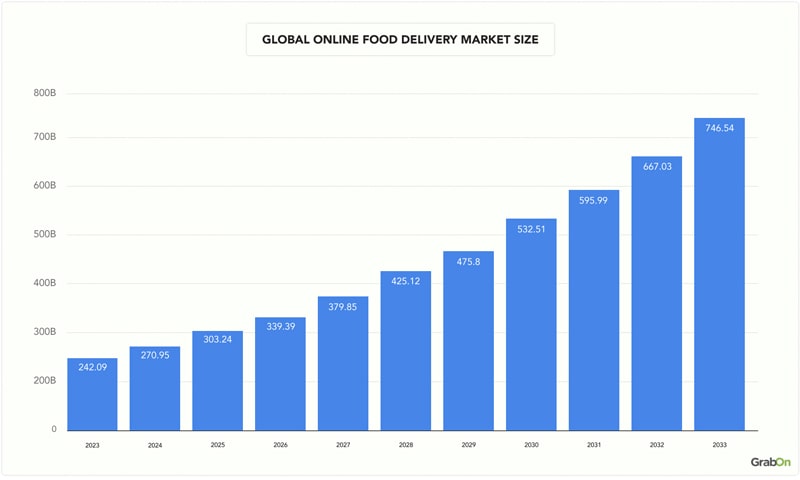
| Year | Market Value (USD Billion) |
| 2023 | 242.09 |
| 2024 | 270.95 |
| 2025 | 303.24 |
| 2026 | 339.39 |
| 2027 | 379.85 |
| 2028 | 425.12 |
| 2029 | 475.8 |
| 2030 | 532.51 |
| 2031 | 595.99 |
| 2032 | 667.03 |
| 2033 | 746.54 |
Source: GlobeNewsWire.
United States Online Food Delivery Market Size
The United States online food delivery market size is $34.28 billion in 2025, up by 9.90% from the previous year. With a CAGR of 9.93% between 2024 and 2032, the market will reach $66.54 billion by 2032.
| Year | Market Value (USD Billion) |
| 2023 | 28.37 |
| 2024 | 31.19 |
| 2025 | 34.28 |
| 2026 | 37.69 |
| 2027 | 41.43 |
| 2028 | 45.54 |
| 2029 | 50.07 |
| 2030 | 55.04 |
| 2031 | 60.50 |
| 2032 | 66.54 |
Source: GlobeNewsWire.
Food Delivery App Market Share in the United States
DoorDash dominates the U.S. food delivery market with a 67% share, far ahead of its closest competitor, Uber Eats, which holds 25%. Grubhub ranks third, capturing the remaining 8% of the market.
Many users prefer platforms like DoorDash not just for convenience but also for the savings they get through ongoing DoorDash Promo Codes.
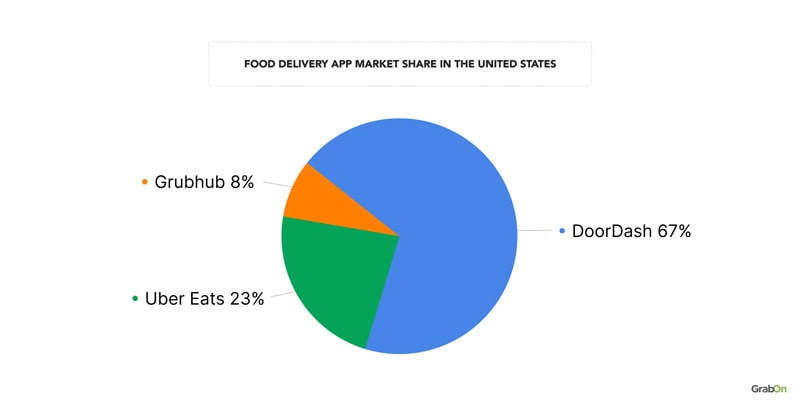
| Food Delivery Service | Market Share in USA |
| DoorDash | 67% |
| Uber Eats | 25% |
| Grubhub | 8% |
Source: BOA.
Food Delivery Service Users Globally
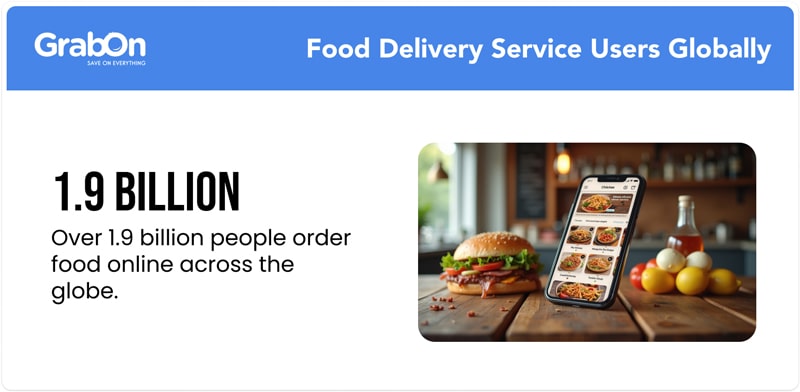
Over 1.9 billion people order food online across the globe; this number is set to reach 2.6 billion by 2026. Additionally, over 2.2 billion people order meals online. it is estimated that the number of users in the meal delivery market will reach 2.5 billion by 2029.
User penetration in the Meal Delivery market is at 28.2% in 2025.
Source: Statista.
37% Of People Think Ordering Via Food Delivery Apps Is Reliable
Over a third (37%) of consumers consider food delivery apps like DoorDash, Uber Eats, JustEat, and Grubhub the most reliable way to order food. They believe these platforms offer the best value and overall experience.
With Uber Eats being a go-to choice for quick meals, many customers take advantage of Uber Eats Promo Codes to enjoy discounts on their favorite orders.
However, 35% still prefer ordering directly from restaurants, while 15% trust only takeaway pickup.
Source: PR Newswire.
The Majority of Consumers Choose Online Food Delivery For Speed and Convenience
About 41% of consumers are more likely to reorder from a restaurant if their food arrives quickly, while 31% prioritize proper food temperature. Additionally, 32% of customers choose one restaurant over another based on delivery speed, and 25% consider location convenience.
Most consumers (38%) agree that 21-30 minutes is the ideal maximum wait time for their order.
Source: PR Newswire.
69% of Consumers Prioritize Taste When Ordering Food
As people watch their spending, food quality remains a top priority. Around 69% of consumers say taste is the most important factor, followed by ingredient quality (67%). Restaurant ratings and customer reviews also influence decisions, with 59% relying on them more than ever. The main reason for repeat orders is good food quality (52%), while 27% choose a restaurant based on menu variety.
Source: PR Newswire.
57% of Americans prefer ordering in
Roughly 57% of Americans prefer to order delivery or takeout, while 43% prefer to dine in at restaurants. Many businesses offer both options to capture both segments.
Source: USFoods.com
The United States and China Are The Two Biggest Grocery Delivery Markets
The grocery delivery market is booming, with rapid growth worldwide. In 2025, global delivery revenue is expected to rise by 22.2%, while the U.S. market is set to grow even faster at 29%. This shift could take business away from traditional grocery stores that struggle to compete with larger or more tech-savvy rivals.
Americans are also spending significantly more on grocery deliveries than other countries. The average U.S. customer is expected to spend $1,520, compared to $531 in China, $464 in Europe, and $457 globally.
Source: Statista.
Food Delivery Market Revenue By Country
China has the highest food delivery market revenue with $46.6 billion/year. The United States of America hits the $17.9 billion figure.
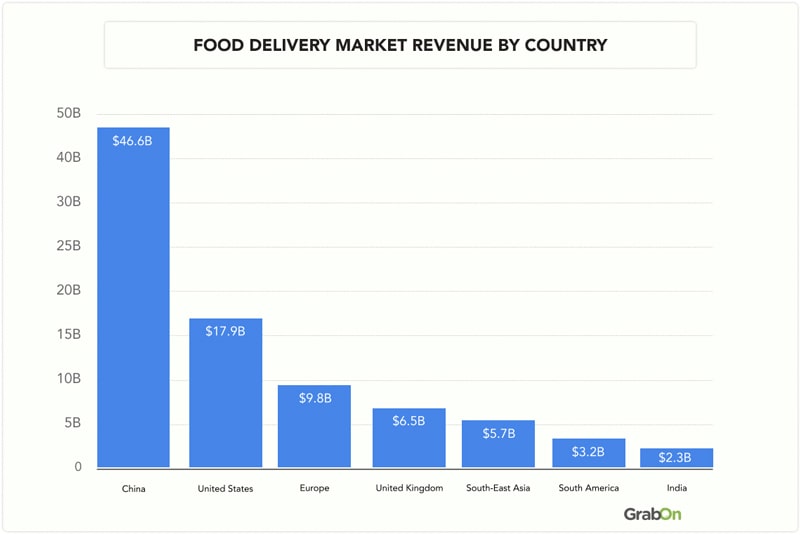
| Country | Food Delivery Market Revenue |
| China | $46.6 billion |
| United States | $17.9 billion |
| Europe | $9.8 billion |
| United Kingdom | $6.5 billion |
| South-East Asia | $5.7 billion |
| South America | $3.2 billion |
| India | $2.3 billion |
Source: BOA.
The True Cost of Food Delivery Services
Food delivery platforms charge restaurants a commission of 15% to 30% per order, which directly affects profit margins. To offset this, many restaurants increase menu prices on third-party apps compared to direct orders or in-person dining.
For customers, additional costs include delivery fees ranging from $2 to $5 per order and service fees that can be as high as 15% of the order total. While these fees don’t impact restaurant earnings, they do increase the overall cost for consumers.
Source: McKinsey.
Americans Spend More on Food Delivery Than Dining In
The average American spends $35.42 per food delivery order, significantly higher than the $22.50 average check for in-house dining at restaurants like Olive Garden. In total, Americans spend over $1566 a year on food delivery services.
Popular dine-in chains like Olive Garden continue to attract customers, especially when they can save more using available Olive Garden Coupons.
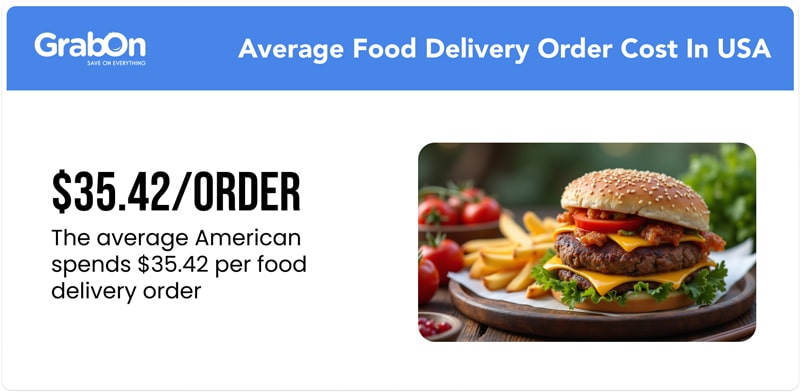
While some of this cost includes delivery and service fees, it suggests that customers are willing to pay extra for convenience. This also indicates an opportunity for restaurants to encourage larger orders by offering add-ons or bundled deals.
Source: Upgraded Points.
Food Delivery App Downloads Globally
Zepto, India’s quick commerce app, which also delivers groceries and food items, was the most downloaded application in 2024 with 70.58 million downloads. Uber Eats took the second place with 42.68 million downloads.
| Food Delivery App | Downloads |
| Zepto: 10-Min Grocery Delivery | 70.58 million |
| Uber Eats: Food & Groceries | 42.68 million |
| Zomato: Food Delivery & Dining | 41.75 million |
| Swiggy Food & Grocery Delivery | 39.18 million |
| Blinkit: Grocery in 10 minutes | 36.17 million |
| DoorDash – Food Delivery | 26.5 million |
| Ele.me | 25.39 million |
| bigbasket: 10-minute Grocery app | 22.48 million |
| foodpanda food & groceries | 21.56 million |
| Zé Delivery de Bebidas | 17.74 million |
| Rappi: Food Delivery, Grocery | 16.02 million |
| iFood comida e mercado em casa | 15.46 million |
Source: Statista.
Emerging Food Delivery Trends
The change in technology, economy, and environment has influenced how people order food. One trend that has stood out in the past year is the rise of Quick Service Restaurants (QSRs). These restaurants are usually hyper-local and offer fast delivery. Restaurants that can provide affordable, high-quality meals that guests can easily customize to their tastes are seeing incredible success. The global quick service restaurant market size was worth $971.36 billion in 2024.
Another emerging trend is sustainability. Users are preferring restaurants that offer sustainable delivery options and use biodegradable packaging. Gen Z and millennials strongly prefer brands that adopt eco-friendly practices.
Source: Deliverect, Fortune Business Insights
Important Food Delivery Market Statistics You Should Know
- More than half of consumers in the US (51%), Canada (54%), New Zealand (52%), and Australia (54%) prefer ordering food delivery through third-party apps or websites.
- In the US (52%), Canada (48%), Australia (43%), and New Zealand (43%), the top reason people order alcohol for delivery is to treat themselves.
- About 31% of Americans use third-party food delivery services at least twice a week. Additionally, 66% of adults say they order food more often now than they did before the pandemic.
- Customers who order directly from restaurants spend 35% more per transaction than those using third-party apps. Offering promotions can help encourage more direct orders.
- Gen Z is shaping food delivery trends, with 69% opting for delivery more than any other generation. They, along with Millennials, are also 27% more likely to support brands that prioritize sustainability, making biodegradable or recyclable packaging a key factor in their choices.
- Social media plays a crucial role in restaurant discovery. TikTok is the top platform for Gen Z in the US when searching for new places to eat, while 23% of Canadian Gen Zers say influencers impact their restaurant choices.
- Most US consumers (63%) eat their takeout or delivery food straight from the container, but Baby Boomers stand out—55% prefer using their own dishes and utensils.