Fake Reviews Statistics 2026: Trust & Consumer Trends

Fake online reviews are projected to cost global consumers an estimated $828 billion in 2026. The digital economy relies completely on social proof, but roughly 30% of all online reviews across major platforms are now estimated to be fabricated. As generative AI tools become cheaper and faster, detecting fraudulent feedback has become a massive technological challenge.
Major consumer platforms and government regulators are aggressively fighting back against this multi-billion-dollar underground industry. The U.S. Federal Trade Commission officially rolled out severe penalties for review manipulation, fining up to $53,088 per violation in 2026.
Below is a comprehensive breakdown of the latest fake review statistics, platform enforcement data, and consumer trust trends shaping 2026.
Top 5 Review Trust Takeaways for 2026
- Tripadvisor protected travelers from more than 2.7 million fake reviews.
- Trustpilot removed 4.5 million fake reviews by using advanced machine learning and specialist moderation teams.
- Yelp permanently closed over 1.3 million user accounts due to violations regarding review authenticity.
- Consumers are 97% more likely to keep using a brand that earns both trust and relevance.
- 46% of US consumers would suspect a review was fake if they believed AI had written it.
How Common Are Fake Online Reviews in 2026
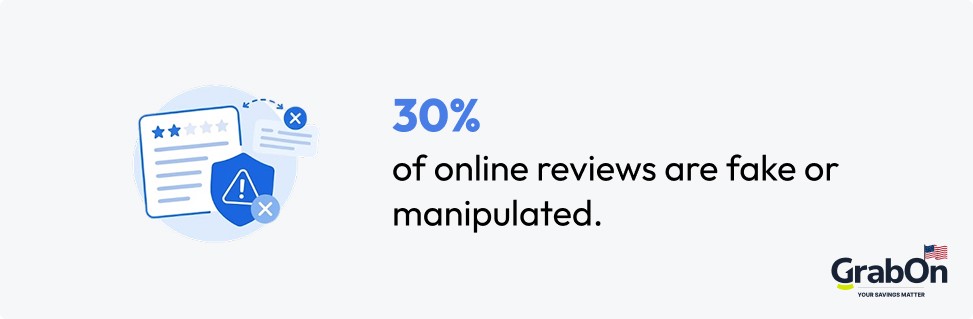
- Roughly 30% of all online reviews across major consumer platforms are estimated to be entirely fake or manipulated.
- Trustpilot removed 4.5 million fake reviews across its network, amounting to 7.4% of the total number of reviews submitted in 2024. In 2023, Trustpilot removed 6.1% of total reviews, demonstrating exactly how its technology is scaling and improving as the number of reviews on the platform increases.
- Based on the consistent year-over-year growth in automated takedowns, industry estimates project that Trustpilot will remove approximately 9% to 10% of its total submitted reviews as fake in 2026.
- About 70% of reviews submitted in 2025 were successfully recommended by Yelp’s automated recommendation software.
- Conversely, 17% of reviews were completely rejected and not recommended by Yelp’s automated recommendation software due to internal authenticity concerns.
- Yelp experienced a massive 58% year-over-year increase in Unusual Activity Alerts and Public Attention Alerts placed directly on local business pages.
(Source: Trustpilot, Yelp, Review42)
The Financial Cost of Fake Reviews on Consumers
- Fake reviews cost online consumers worldwide an estimated $770.7 billion in 2025 by driving them toward purchases they would not have made with accurate information.
- By 2030, current market projections suggest that the global consumer cost of review fraud will steadily climb to $1.07 trillion.
- The average consumer wastes roughly $125 per year on products purchased entirely because of deceptive or fabricated reviews.
- Review fraud actively causes approximately $300 billion in annual consumer harm specifically within professional services like home repair, legal representation, and medical care.
- The U.S. Federal Trade Commission previously determined that a business purchasing fake reviews can generate a 1,900% return on investment.
(Source: WiserNotify, Review42, YouGov)
AI-Generated Reviews: A Growing Threat to Review Authenticity
Previously, spam was easy to identify due to poor grammar, repetitive phrasing, and obvious linguistic errors. Today, bad actors use large language models to generate thousands of highly convincing, contextually relevant fake reviews in mere seconds.
- A growing 46% of everyday customers are now highly suspicious of reviews that read like they were written by artificial intelligence.
- AI-generated reviews are estimated to have grown at a massive rate of roughly 80% month-over-month since mid-2023.
- Yelp’s automated systems proactively identified and filtered out nearly 500,000 suspected AI-generated reviews in 2025 alone.
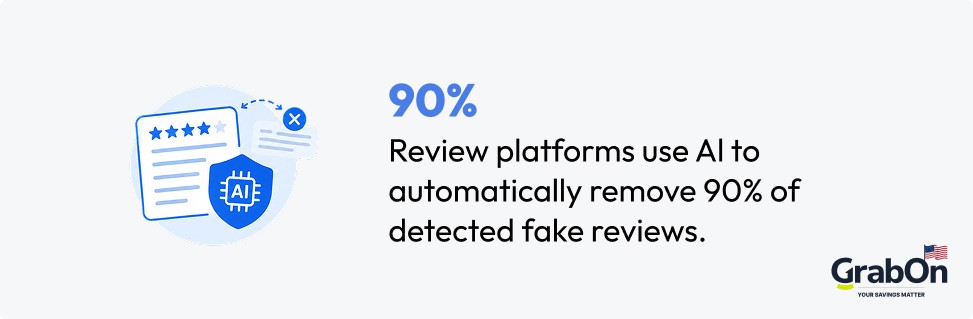
- The growing use of internal artificial intelligence helps major review platforms automatically remove 90% of their detected fake reviews.
- The implementation of AI and machine learning, used in conjunction with Trustpilot’s specialist teams, directly led to 53% more reviews being removed automatically than in 2023.
This massive increase in automated takedowns thoroughly demonstrates the critical importance of AI in maintaining integrity as review platforms grow.
(Sources: Forbes, Review42, Yelp, Trustpilot)
Review Platform Moderation and Automated Defenses
To maintain consumer confidence, review platforms must perfectly analyze millions of data points every single hour. Automated software handles most submissions, while human teams step in for complex disputes.
- 100% of reviews submitted to the Tripadvisor platform are strictly analyzed using a proprietary technology system aimed at detecting violations of its core policies.
- A massive 87.8% of total reviews on Tripadvisor were safely posted automatically in 2024. Conversely, 7.3% of the submissions were auto-rejected by the system before they could ever be posted publicly.
- Tripadvisor’s proprietary technology also flagged 4.9% of submissions for further review by a dedicated team of human moderators.
When Tripadvisor’s advanced screening technology can neither entirely reject nor clear a review, a team of experts working 24/7 across 23 languages comprehensively assesses the submission.
- In 2024, more than 1.5 million reviews required strict human moderation at the exact point of submission.
- The Tripadvisor Trust and Safety team physically moderated 4.2 million reviews, which equals 13.5% of all reviews, either before or after posting. Ultimately, professional human moderators removed 8.87% of all reviews for any platform violation in 2024.
| Tripadvisor Moderation Category | Percentage or Volume | Action Taken by Platform |
| Automatically Posted | 87.8% | Cleared instantly by proprietary technology without human intervention. |
| Auto-Rejected | 7.3% | Blocked permanently before ever reaching the public profile. |
| Flagged for Review | 4.9% | Sent directly to human moderators for strict compliance checks. |
| Human Moderation Required | 1.5 Million | Handled entirely manually at the time of submission. |
| Total Reviews Removed | 8.87% | Removed entirely for strictly violating any community guideline. |
- Yelp’s User Operations team permanently closed over 1.3 million user accounts for violating its Terms of Service, a staggering 138% increase from 2024.
- The platform rapidly rejected over 50,700 potential new business pages specifically associated with spammy behavior, representing a 29% increase from 2024.
- Yelp actively removed more than 1,340 business pages that were definitively linked to deceitful online lead generators.
- Yelp placed exactly 363 Suspicious Review Activity Alerts directly on business pages linked to suspicious review patterns.
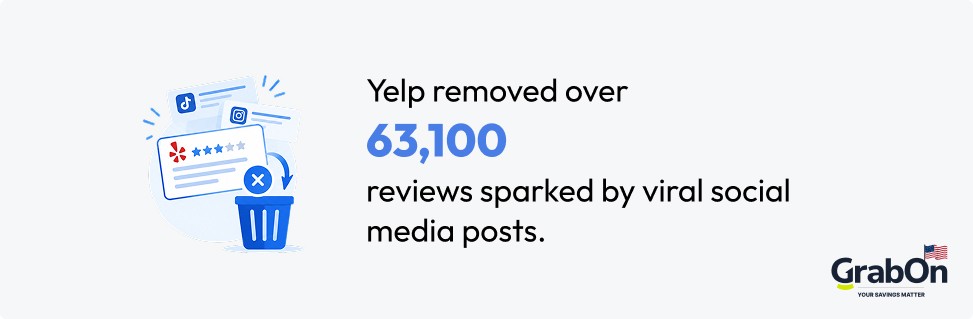
- Viral social media-related incidents resulted in the removal of more than 63,100 targeted reviews on Yelp.
- Yelp actively placed 6 Questionable Legal Threat Alerts on business pages over serious concerns about businesses using legal action to illegally suppress honest consumer reviews.
(Source: Yelp, Tripadvisor Transparency Report)
Cross-Platform Cooperation to Stop Fake Reviews
- Nearly 2,000 user accounts were permanently closed for direct involvement in review exchange rings or other suspicious review activity, marking a 49% increase from previous years.
- Yelp actively identified more than 1,100 suspicious groups, posts, or individuals explicitly involved in review trading, representing a 45% increase from 2024.
- In 2025, Yelp made more than 1,020 direct reports to other online platforms about specific content attempting to trade or pay for reviews.
Yelp also warns networks like Instagram, Facebook, X, Reddit, and TikTok about suspicious actors.
- Collaborative industry efforts are making a massive impact, as 60% of Yelp’s reports resulted in immediate action being taken to remove deceptive content.
This success represents a 62% increase in the cross-platform action rate from 2024, perfectly underscoring growing cooperation across the tech industry.
(Source: Yelp)
Community Enforcement and Dispute Resolution
User reporting plays an important role in keeping review platforms clean. Automated algorithms cannot always catch everything, and consumers or business owners are usually the first to notice a localized review attack.
- The global Tripadvisor community plays an important role as a third critical layer to content integrity. The platform actively encourages business owners and travelers to use the content flagging system to help identify issues and support moderation.
In 2024, the platform received exactly 244,000 review disputes directly from members of its global community.
- When a specific review is contested by a user, Tripadvisor investigates the details and responds appropriately.
Of all the reviews explicitly contested by the community in 2024, over 80% were completely addressed and officially resolved within 24 hours.
(Source: Tripadvisor)
Reasons for Review Removal and Policy Violations
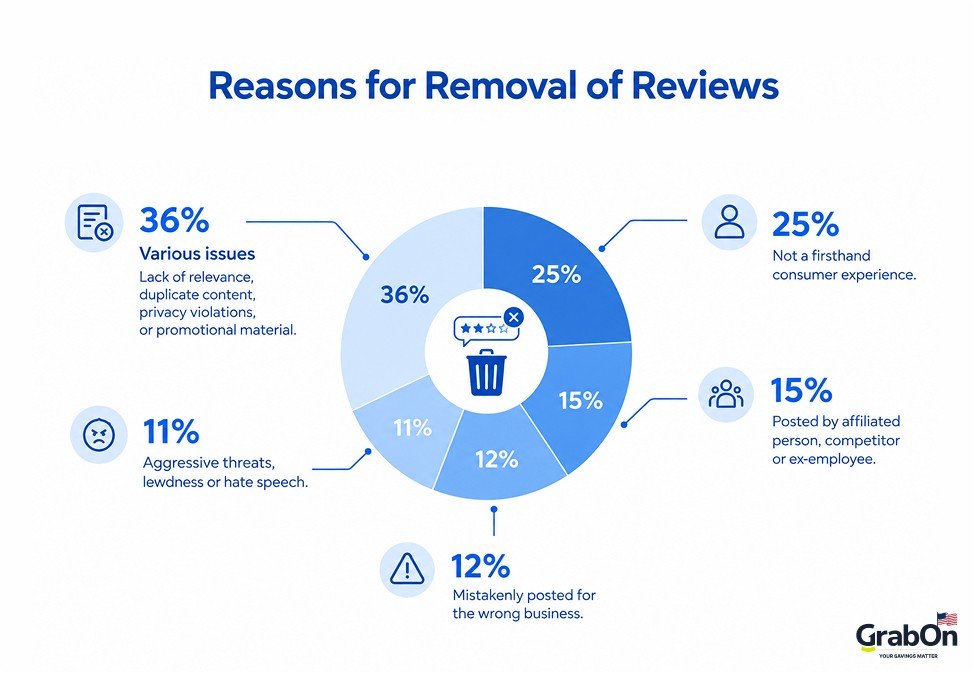
- The leading reason Yelp removed reported reviews in 2025 was that the content was not a firsthand consumer experience, accounting for 25% of removals.
- Reviews deliberately posted by someone directly affiliated with the business, a direct competitor, or an ex-employee made up 15% of the removed content.
- Simple user error accounted for a significant portion, as reviews mistakenly posted for the wrong business constituted 12% of removals.
- Content containing aggressive threats, lewdness, or targeted hate speech accounted for 11% of the removed reviews.
- The remaining 36% of removed reviews were taken down for various ongoing issues like a lack of relevance, duplicate content, privacy violations, or promotional material.
(Source: Yelp)
FTC Regulations and Legal Penalties for Fake Reviews
The Federal Trade Commission (FTC) officially enacted a strict =rule regarding consumer reviews and testimonials, placing massive financial penalties on businesses that attempt to cheat the system.
- The FTC’s new fake reviews rule officially took effect in October 2024 and targets businesses that write, sell, buy, or knowingly disseminate fraudulent ratings.
- Knowing violations of this rule can legally cost an offending business up to $53,088 per individual violation, a massive penalty that remains in effect through 2026.
- The FTC explicitly bans paying for reviews or offering any form of reward or incentive that ultimately requires the reviewer to express a positive sentiment.
- Businesses are strictly prohibited from using artificial intelligence to produce fake reviews from customers who never actually purchased anything.
- The rule also permanently bans review suppression, making it highly illegal to use groundless legal threats or intimidation to force a consumer to remove a negative review.
- Federal enforcement actions heavily increased throughout 2025 and 2026, quickly shifting from standard warning letters to federal lawsuits that seek maximum civil penalties.
The Impact of Trusted Reviews in Driving Brand Loyalty
- Globally, consumers are nearly twice as willing to support a brand expanding to new audiences if it has earned both trust and relevance.
- Consumers who completely trust brands and feel they are highly relevant are 35 points more likely to stick with the brand.
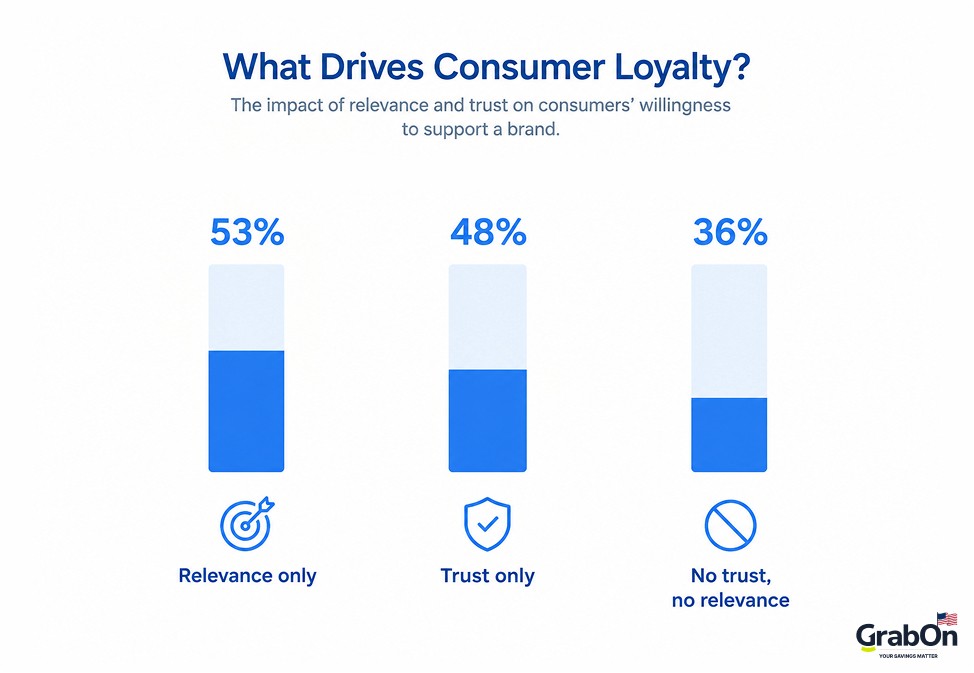
- If a specific brand successfully manages to establish relevance only, that consumer loyalty number slightly drops to 53%.
- If a brand manages to establish trust only, that consumer loyalty number drops further down to 48%.
- When there is absolutely no trust and strictly no relevance, only 36% of consumers actively express a willingness to continue supporting the brand.
To build real trust, brands must let their customers do the talking. Edelman’s 2026 Trust Barometer data shows that people care far more about the honest opinions of real, everyday customers than any corporate advertising.
- Genuine customer reviews are the ultimate trust-builder, driving 41% of consumer trust, making them one of the most powerful factors.
- Self-promotion falls short, as what a brand says about itself only influences 20% of shoppers.
- Paid reviews are less convincing, with sponsored influencers driving just 13% of consumer trust.
- What AI tools or digital assistants say about a specific brand carries the absolute lowest impact, influencing just 3% of consumers.
| Information Source | Impact on Consumer Trust |
| What people who are not paid by the brand say about it | 41% Impact |
| What the brand says about itself | 20% Impact |
| What independent organizations say about the brand | 16% Impact |
| What people who are paid by the brand say about it | 13% Impact |
| What AI tools or assistants say about the brand | 3% Impact |
(Source: Edelman)
How to Identify Fake Online Reviews
- Real reviews usually build up slowly over time, so a sudden and massive flow of perfect ratings appearing out of nowhere is a major red flag.
- Genuine customers tend to share specific details about what they bought, while fake reviews stick to lazy, generic praise like just saying “Awesome product.”
- A quick peek at a reviewer’s profile can easily expose if the account was recently created solely to leave one perfect rating.
- SEO manipulators often heavily stuff their fake reviews with exact-match keywords and targeted city locations to illegally trick local search algorithms.
- If you scroll through a business page and notice several different people using the same phrase or sentence, you are almost certainly looking at automated spam.
To Conclude
In the coming years, review authenticity will become a competitive advantage, not just a trust signal. As AI makes fake reviews harder to detect, brands that prioritize verified customer experiences, transparent review practices, and genuine relevance will be better positioned to earn lasting loyalty. The future belongs to brands that can prove their credibility, not simply promote it.