Uber Eats Top Statistics And Trends 2025

Uber Eats continues to deliver impressive numbers in the food delivery sector. With over 95 million users and bookings worth $21.7 billion in Q2 2025, Uber Eats has a 23% share of the US food delivery market.
Key trends shaping Uber Eats in 2025 include a heightened focus on sustainability, with initiatives to reduce carbon emissions and promote eco-friendly packaging. Additionally, AI and machine learning are optimizing delivery routes, enhancing customer service, and personalizing user experiences.
Let’s take a look at several key statistics that highlight Uber Eats’ impressive growth in 2025.
Uber Eats Statistics 2025 – Top Picks
- Over 95 million users worldwide use Uber Eats.
- Uber Eats holds a 23% market share in the US food delivery market.
- Uber Eats had gross orders worth $21.73 billion in Q2 2025.
- As of 2025, Uber Eats partners with over 1.5 million merchants.
- Uber Eats has 3.5 million active drivers and delivery personnel.
How many people use Uber Eats?
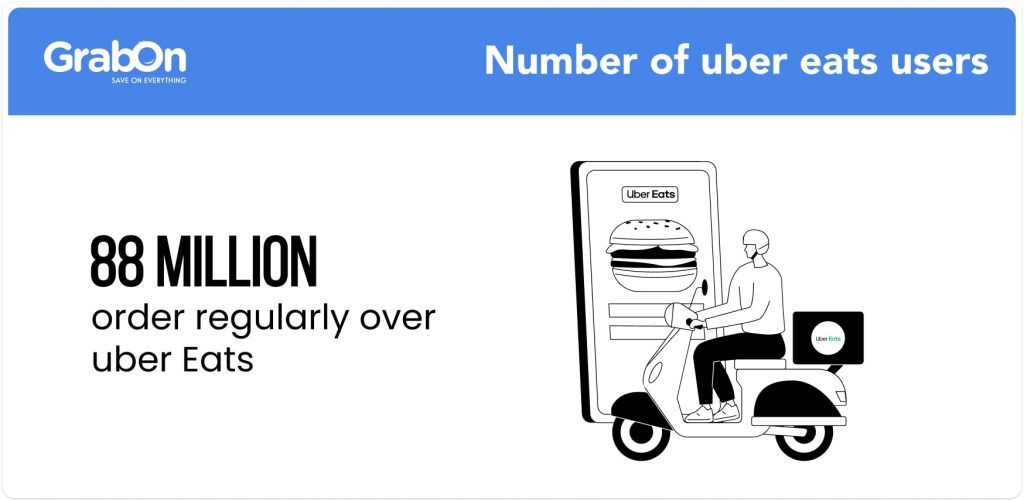
01. There are at least 95 million regular users of Uber Eats worldwide, making it one of the most popular food delivery apps.
(Source: Business of Apps)
Uber Eats User Demographics
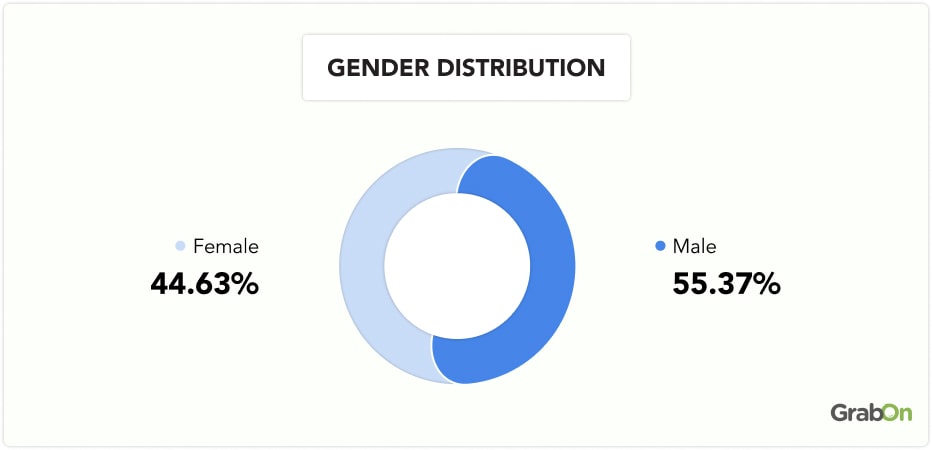
02. The user base of Uber Eats exhibits a relatively balanced gender distribution, with males constituting 55.37% and females making up 44.63% of its customers.
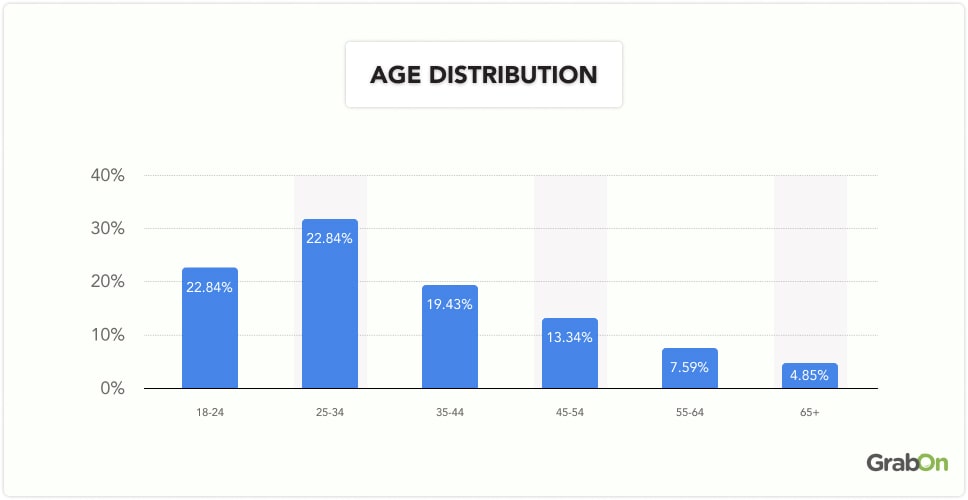
03. The 25-34 age group uses Uber Eats the most, followed by the 18-24 age group.
(Source: Similarweb)
Uber Eats Engagement Statistics
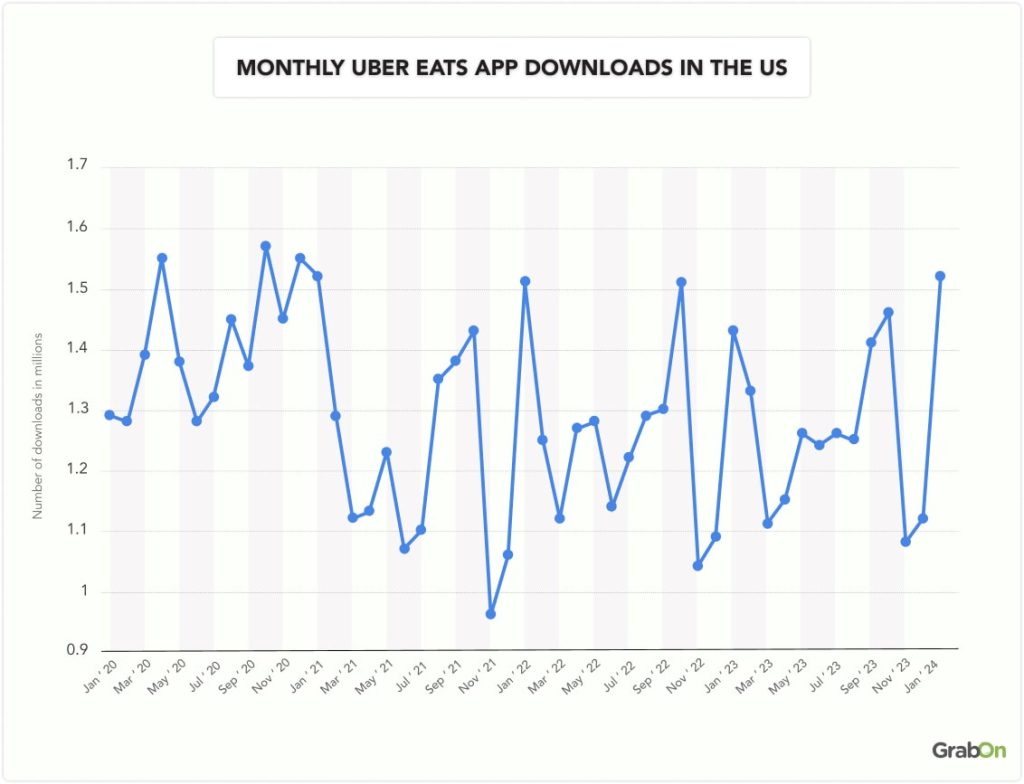
04. Uber Eats’ app had 1.52 million downloads in January 2024, much higher than its December 2023 download count of 1.12 million.
- Uber Eats ranks third in the Food and Drink category in the App Store and Google Play Store.
(Source: Statista, Uber Suggest, Similarweb, Earthweb)
How much is Uber Eats worth?
- Uber Eats is valued at $20 billion as of 2025. Its parent company, Uber Technologies Inc., has a valuation of $120 billion.
Over the years, Uber Eats has seen significant growth in its valuation. In 2020, the platform was valued at around $18 billion, reflecting its rapid expansion and increasing market share. By 2022, its valuation had risen to $20 billion, driven by its continued success and strategic acquisitions.
(Source: SignHouse)
How much money does Uber Eats make?
- Uber Eats revenue reached $3.78 billion, up 18% YoY (22% constant-currency growth).
Uber Eats Annual Revenue (2017 to 2023)
| Year | Revenue |
| 2017 | $0.6 billion |
| 2018 | $1.5 billion |
| 2019 | $1.9 billion |
| 2020 | $4.8 billion |
| 2021 | $8.3 billion |
| 2022 | $10.9 billion |
| 2023 | $12.1 billion |
| 2024 (Q1) | $3.2 billion |
| 2025 (Q2) | $3.78 billion |
Uber Eats Market Share
08. Uber Eats has a 23% market share in the US, falling second to DoorDash’s market share of 67%.
| Food Delivery Platform | Market Share in USA |
| Doordash | 67% |
| Uber Eats | 23% |
| Grubhub | 8% |
| Postmates | 2% |
09. Uber Eats delivers to approximately 70% of the United States population, offering many food options and convenience to residents nationwide.
| Pro Tip: Cut down on your cab booking costs with exclusive Uber promo codes. You can get up to 30% off your daily rides and receive codes for saving up to 50% on your first two rides. |
(Sources: Statista, WifiTalents)
How many people deliver for Uber Eats?
- Uber Eats had 3.5 million active drivers and delivery personnel in 2024, who carried out deliveries in 30 minutes on average.
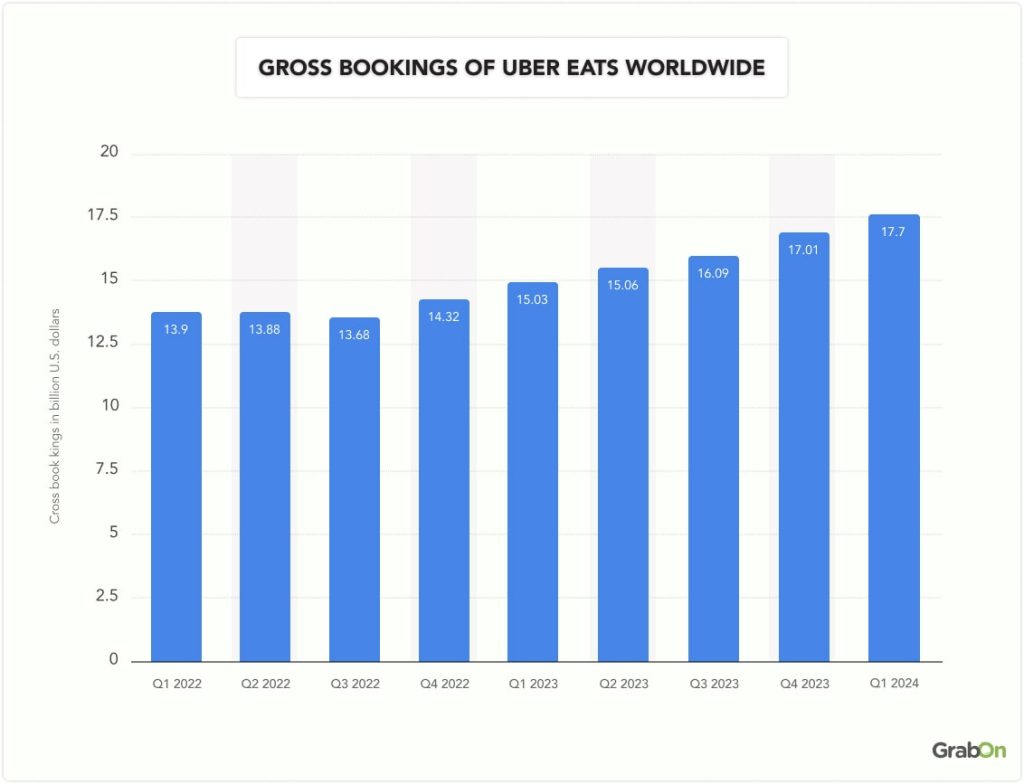
- Uber Eats has grown over the past few years. In the second quarter of 2025, Uber Eats’ global gross bookings reached $21.73 billion, up from around $13.9 billion in the first quarter of 2022.
11. This growth is fueled by strategic partnerships with major restaurant chains, the success of the Uber One subscription program, and continuous innovations in AI-powered logistics and autonomous delivery.
(Sources: Statista, WifiTalents)
How many orders does Uber Eats get in a day?
- Uber Eats processes approximately 5 million orders per day, highlighting its extensive global reach and popularity among users.
Also, the average Uber Eats driver completes around 5 to 8 daily deliveries, and the registered restaurants get around 8 to 60 orders daily.
Number of cities where Uber Eats is available
13. Uber Eats boasts a global presence, with its food delivery services accessible in over 45 countries and spanning more than 11,000 cities worldwide.
(Source: Wikipedia)
Number of Uber Eats partnered restaurants
- Uber Eats collaborates with a vast network of over 1.5 million merchant partners globally, including various businesses from restaurants and grocery stores to florists and liquor stores.
| Year | Supported Restaurants |
| 2017 | 80,000 |
| 2018 | 100,000 |
| 2019 | 220,000 |
| 2020 | 600,000 |
| 2021 | 900,000 |
| 2022 | 825,000 |
| 2023 | 890,000 |
| 2024 | 1 million |
| 2025 | 1.5 million |
(Source: Uber, Uber Newsroom)
Slowest Days for Uber Eats
- Monday and Tuesday are commonly the slowest days of the week for Uber Eats. Following a weekend filled with dining out or online-delivered meals, many people start their workweek with food made at home or meals from their workplace.
Uber’s Revenue by Segment
- Mobility (ride-hailing) remains Uber’s largest segment by revenue, contributing 46% of total revenue in 2025 Q1.
- Delivery (Uber Eats) is the second-largest segment, contributing 33% of total revenue.
- Freight saw a modest decline in revenue, reflecting continued softness in the freight market.
Uber’s total revenue for Q1 2025 was about $11.53 billion, with all segments (except Freight) showing strong growth.
| Uber Segment | Revenue in Q1 2025 | Year-over-Year Growth |
| Mobility | $5.31B | 0.15 |
| Delivery (Uber Eats) | $3.78B | 0.18 |
| Freight | $1.27B | declined by 2% |
(Source: Uber)
Uber Eats Vs. DoorDash: Which food delivery app wins?
Uber Eats and DoorDash have revolutionized how we enjoy meals from our favorite restaurants, offering convenience at our fingertips. Whether it’s a craving for a late-night snack or a gourmet meal, Uber Eats and DoorDash promise to deliver satisfaction to your door. Now, let’s compare these two leading food delivery applications in the US.
| Particulars | UberEats | Doordash |
| Earning Structure | Base fare + distance/time + potential surge pricing | Base pay + pay per delivery/mile + bonuses/incentives |
| Registration Process | Requires driver’s license, vehicle type, insurance, background check | Similar requirements, orientation process |
| Pay Scale | Variable earnings, influenced by factors like location and demand | Guaranteed minimum earnings visible before accepting orders |
| Flexibility | Flexible scheduling, work as much or as little as desired | Schedule shifts or work on-demand, flexibility in earning opportunities |
| Base Delivery Fees | Varies based on location and market conditions | Varies based on location and order size |
| Tip Amount | Directly impacts driver earnings, given by customers | Directly impacts earnings given by customers |
| Customer Base | Broad reach, international presence | Focus on suburban and smaller markets |
| Overall Popularity | Global presence, widely recognized | Strong market share in the United States |
- DoorDash continues to lead in the U.S. food delivery market with a significant share. DoorDash has a 59% market share, while Uber Eats accounts for 24%.
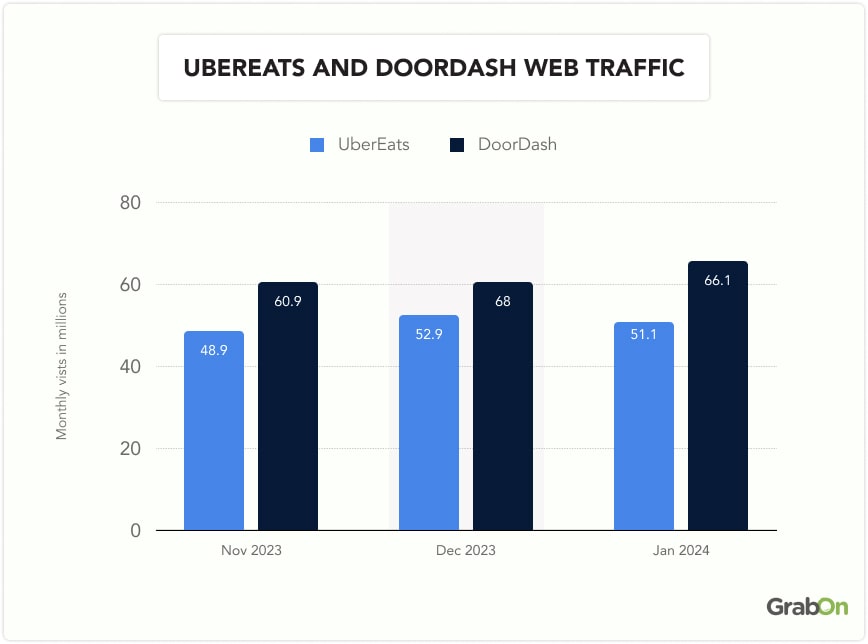
- Doordash continues to get higher web traffic than Uber Eats by 25.6% as of January 2024.
- DoorDash’s service fees are typically around 10 to 11% of the order subtotal, whereas Uber Eats’ service fees can be as much as
- DoorDash & Uber Eats offer a base pay, with additional tips and surge pricing earnings. On average, Uber Eats and DoorDash drivers earn around $19 per hour.
- DoorDash’s market share in the US is 66% bigger than Uber Eats, although the latter has a broader geographical coverage.
(Sources: The Ascent, CNET, Statista, The Ride Share Guy)
Uber Eats Vs. Grubhub
User Base
Uber Eats has a significantly larger user base compared to Grubhub. With around 88 million users, Uber Eats is a popular choice for food delivery.
In contrast, Grubhub has about 28.3 million active monthly app users, which is still substantial but much smaller in comparison. This larger user base for Uber Eats can lead to more frequent orders and potentially higher earnings for drivers.
Average Order Value
When it comes to the cost of orders, Grubhub tends to be the cheaper option for larger orders around $50. This is due to lower delivery fees & better deals for bulk orders.
On the other hand, Uber Eats is typically more cost-effective for smaller orders around $25 or $30. This makes Uber Eats a preferred choice for individuals or small groups looking for quick and affordable meal options.
Delivery Time
Uber Eats has the fastest delivery time, averaging 35 minutes and 31 seconds. This quick delivery time can be attributed to Uber Eats’ efficient logistics and large network of delivery partners.
In comparison, Grubhub’s average delivery time was 50 minutes, significantly longer. Faster delivery times can enhance customer satisfaction and lead to more repeat orders for Uber Eats.
Market Share
As of 2023, Uber Eats has a market share of 23%, and Grubhub has an 8% market share in the food delivery industry. This indicates Uber Eats maintains a strong position in the industry. Grubhub, while smaller, continues to be a significant competitor.
(Source: Apps Rhino, QSR, Scoop Market, Uber, CNET)
Interesting Uber Eats Facts
- Uber Eats users usually tip around 10-15% of the order value.
- The average delivery time for Uber Eats is around 30 minutes.
- Uber Eats is particularly popular in countries like the United States, Japan, and France.
- Uber’s CEO once gave delivering food orders a go. After 3.5 hours of hard work, he earned $106.
- During the pandemic, a customer placed a $7,719.82 order via Uber Eats.
- The pickiest eaters on Uber Eats in the US reportedly live in New York, Connecticut, New Jersey, Illinois, and Georgia.
- Uber Eats doesn’t only deliver food, it can also get you groceries, prescriptions, flowers, and alcohol.
- Uber Eats users have donated $3 million to restaurants through the “Support this restaurant” option.
- Costco partners with Uber Eats for its grocery delivery services.
- Some of the most ordered items on Uber Eats include french fries, garlic naan, and pad thai.
Latest Trends in the Food Delivery Market
The food delivery market in the USA is marked by significant growth, driven by changing consumer behaviors, technological advancements, and evolving business models. Key trends shaping the U.S. food delivery landscape include strong market expansion, prominence of major platforms, adoption of AI and automation, subscription models, and sustainability focus.
- AI is increasingly used for personalized meal recommendations, order automation, and reducing wait times (e.g., Wendy’s AI ordering decreased drive-thru wait time by 22 seconds).
- Companies like Serve Robotics are expanding robot delivery partnerships (e.g. with DoorDash) to handle short-distance last-mile deliveries in cities such as Los Angeles, Miami, Chicago, and Atlanta.
- Uber Eats is partnering with Flytrex to launch drone-based meal delivery in select U.S. markets by the end of 2025.
- Autonomous delivery technologies (drones and robots) are being piloted to reduce costs and increase efficiency.
- Subscription services offering scheduled meal deliveries and perks (free shipping, exclusive items) are growing in popularity.
- Restaurants spend around $24 billion annually on disposable food containers, highlighting focus areas for sustainability efforts.
- Millennials and Gen Z are key customers for online food delivery services, valuing speed, convenience, and personalized digital experiences.
- Many consumers expect live tracking, fast delivery times (30 minutes or less in many urban areas), and smooth app experiences.
(Sources: Deliverect)
Interesting FAQs about Uber Eats
Uber Eats, a leading food delivery platform, offers convenience and a wide variety of dining options. As its popularity grows, users often have questions about how the service works, its features, and how to get the most out of it. Here are some interesting FAQs that can help users navigate and maximize their Uber Eats experience.
How long has Uber Eats been around?
Uber Eats has been around since August 2014. It initially launched as UberFRESH in Santa Monica, California, before being rebranded to Uber Eats in 2015. Since then, it has expanded significantly and is now available in over 6,000 cities across 45 countries.
Is Uber or Uber Eats more profitable?
Uber’s ride-hailing segment is generally more profitable than Uber Eats. While Uber Eats has seen significant revenue growth, especially during the pandemic, it has struggled with overall profitability. In contrast, Uber’s ride-hailing business has consistently been a major revenue driver and has returned to profitability after the initial pandemic impact.
How to make $1,000 with Uber Eats?
Making $1,000 with Uber Eats is achievable with the right strategies. Here are some tips to help you reach that goal:
- Work During Peak Hours: Deliver during high-demand times like lunch (11 AM – 2 PM) and dinner (5 PM – 9 PM), as well as weekends and holidays.
- Choose Busy Areas: Focus on areas with a high concentration of restaurants and customers. This can help you get more orders and reduce downtime.
- Maximize Tips: Provide excellent service by being punctual, communicating with customers, and ensuring orders are accurate. A friendly profile picture can also help increase tips.
- Use Multiple Apps: Consider working for other delivery apps like DoorDash or Grubhub simultaneously to maximize your earnings.
- Take Advantage of Promotions: Keep an eye out for Uber’s boost earnings and surge pricing during peak times or special events.
- Track Your Performance: Analyze your delivery history to identify the most profitable times and areas for you.
Does Uber Eats pay more than DoorDash?
Uber Eats and DoorDash pay can vary, but generally, DoorDash drivers earn between $15 and $25 per hour, while Uber Eats drivers average around $19 per hour. Your earnings will depend on factors like location, demand, and tips, so some drivers may find one platform more profitable than the other.